

DOOLITTLE RAID PAYBACK FOR PEARL HARBOR
Aboard the USS Hornet • April 18, 1942
The Doolittle Raid—a top-secret U.S. retaliatory airstrike following the surprise Japanese bombing of American naval and air bases at Pearl Harbor, Hawaii, 19 weeks earlier—was the country’s first joint action with the U.S. Army Air Forces and the U.S. Navy. The groundbreaking mission shipped 16 North American B‑25B Mitchell land-based medium bombers and their five-man aircrews aboard America’s newest aircraft carrier, the USS Hornet, to within 600 miles/966 kilometers of the Japanese coastline from a position deep in the Western Pacific Ocean. The mission, which took place on this date, April 18, 1942, climaxed with each warplane, with the exception of one, unloading 2 tons of ordinance on targets on the main (largest) island of Honshū.
The leader of the improbable raid on the Japanese heartland was the legendary 45‑year-old aviator and World War I pilot Lt. Col. James H. “Jimmy” Doolittle. The plan called for the aviators to bomb military targets and to continue westward across the East China Sea to land in regions of China controlled by U.S.-supported Nationalists; landing a returning medium bomber on a flattop was out of the question. The bombing raid on the Japanese capital Tokyo (13 bombers), Nagoya, Yokohama, and Kobe (one plane each) destroyed 112 buildings and damaged 53, killed 87 Japanese, including civilians (some were school children, a hazard of war), and injured 162 (possibly 311), nearly half seriously.
Having spread destruction across 200‑plus miles/roughly 322 kilometers and now low on fuel, 15 out of the 16 warbirds managed to reach mainland China, some crews bailing out over land or water while others crash-landed their aircraft. The eighth Mitchell to lift off from the Hornet made an inauspicious landing at Vladivostok, the largest Soviet port city on the Pacific coast some 660 air miles/1,062 kilometers north of Tokyo. Amazingly, 77 of the 80 crew members initially survived the mission, aided by local Chinese and Christian missionaries. Eight airmen were captured by the Japanese Army in China. Three of the captives were later beheaded, another starved to death in prison, and the other 4 languished for 40 months in POW camps. The crewmen who landed in the Soviet Union were interned for 13 months before being released through Iran.
The consequences of the Doolittle Raid had major psychological effects. In the United States, it raised American spirits after the demoralizing disaster at Pearl Harbor. In Japan, it raised doubt at the highest and lowest levels of the populace about the ability of their military leaders, who insisted the Home Islands were impervious to attack, to defend the nation. But the bombing and strafing of civilians also steeled the resolve of many Japanese to seek revenge and was exploited for propaganda purposes. The death of the school children was especially infuriating.
Altogether, the injuries, fatalities, property destruction, and national humiliation brought on by the Doolittle Raid contributed to Adm. Isoroku Yamamoto’s disastrous decision, as it turned out, to extend the nation’s watery defensive perimeter by grabbing U.S.-held Midway Island in the Central Pacific that cost the Imperial Japanese Navy 4 flattops and shifted the balance of power in the Pacific in favor of the U.S. at the Battle of Midway (June 4‑7, 1942). Number-wise, the consequences fell most severely on the Chinese. Japanese reprisals (the Zhejiang-Jiangxi Campaign), which went on for months, cost an estimated 250,000 lives, some victims being set on fire, thrown down wells, many shot singly or in large groups, some dying from the effects of plague, anthrax, cholera, typhoid, and dysentery unleashed by the secretive Unit 731, which specialized in bacteriological warfare. Reprisals also included rapes of children and adults and the widespread destruction of livestock, crops, as well as homes, hospitals, utilities, military installations, and airfields. Some of the last 2 listed facilities the U.S. military had hoped to use in future operations against Japan.
The U.S. Doolittle Raid on the Japanese Homeland, April 18, 1942
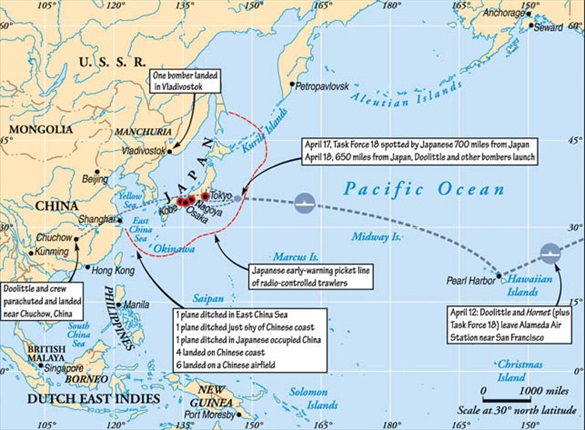 |
Above: Map showing the routes and the landing or crash sites of Doolittle’s Raiders. A daring, near-suicidal airstrike by 80 U.S. Army aviators placed a small down payment on what Americans believed they owed Japan for that country’s perfidy on December 7, 1941. Except for 1 crewman who was killed in action and 3 who were captured by the Japanese Army in China and executed, 14 complete crews of five men each survived the hazardous raid and its aftermath. Newsreel footage of the raid was widely distributed, and the book Thirty Seconds Over Tokyo, written by Lt. Ted Lawson, a pilot on the raid, was a 1943 national bestseller. (Lawson had to have one of his legs amputated after the famous raid.) The book was turned into a critically acclaimed 1944 movie starring Spencer Tracy as Lt. Col. Jimmy Doolittle and Van Johnson, in his breakout role, as Lawson. The movie was a long-running favorite with audiences.
 |
 |
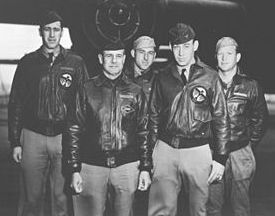
Left: Crew members of Doolittle’s North American B‑25 Mitchell, the lead bomber, pose for posterity just before takeoff from U.S. Navy aircraft carrier USS Hornet, April 18, 1942, on its first combat mission. Left to right: Lt. Henry A. Potter, navigator; Lt. Col. James H. Doolittle, pilot; Staff Sergeant Fred A. Braemer, bombardier; Lt. Richard E. Cole, co-pilot; and Staff Sergeant Paul J. Leonard, flight engineer/gunner. Doolittle put the odds of his raiders returning alive at less than 50-50. However, the raid was over so quickly that only a few enemy fighters had time to intercept the intruders. Vice Adm. William Halsey, Jr., who commanded the task force that transported the raiders to their launch position, praised Doolittle, telling him that he knew of no more gallant deed in history than that performed by his squadron. “You have made history,” he wrote. President Franklin D. Roosevelt presented Doolittle with the Medal of Honor and the other 79 Raiders received the Distinguished Service Cross. Doolittle went on to command U.S. air forces in the Mediterranean, Western Europe, and Japan (Okinawa).
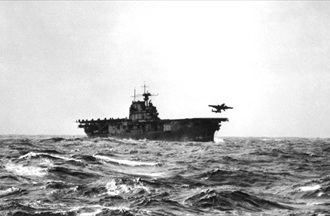
Right: The Doolittle Raiders carried the battle against the enemy to the heart of the Japanese empire with a surprise raid on mostly military and war-related objectives in major Japanese cities: a petroleum warehouse, commercial workshops, a Mitsubishi Heavy Industries aircraft factory, the Japanese Steel Corporation and Showa Electric as well as the Yokosuka Naval Base and an army arsenal and hospital. (The Raiders had explicit orders not to bomb Emperor Hirohito’s palace.) The successful raid, which caught the Japanese completely off guard but had little tactical impact, was the result of coordination between 2 American armed services: the U.S. Navy, whose newest aircraft carrier positioned the raiders’ 16 B‑25 twin-engine bombers to within take-off distance of the Japanese Home Islands, and the 80 volunteer pilots, navigators, and bombardiers of the U.S. Army Air Forces. Despite rough seas and a threatening sky on launch day, Saturday, April 18, 1942, the B‑25 in his photo—probably Doolittle’s lead bomber—successfully took off from the pitching, spray-soaked flight deck of the USS Hornet en route to Japan. The Hornet was embedded in a full Navy task force that comprised a second aircraft carrier, the Enterprise, 4 cruisers, 8 destroyers, and 2 oilers.
Contemporary Newsreel of Historic Doolittle Raid over Tokyo

World War II was the single most devastating and horrific event in the history of the world, causing the death of some 70 million people, reshaping the political map of the twentieth century and ushering in a new era of world history. Every day The Daily Chronicles brings you a new story from the annals of World War II with a vision to preserve the memory of those who suffered in the greatest military conflict the world has ever seen.