

“DAMBUSTERS” BREACH RUHR DAMS
London, England · May 16, 1943
At least since 1937, two years before the outbreak of European hostilities, British intelligence had looked into developing alternative ways to destroy German factories in the Ruhr Valley, Germany’s industrial heartland. Late on this date in 1943 in Germany, a British squadron of nineteen modified Avro Lancaster bombers, each with a 9,250‑lb payload of one externally mounted, specially designed “bouncing bomb” (actually, a revolving depth charge), flew toward three dams on the Moehne and Eder rivers in the Ruhr Valley. The “dambusters” in Operation Chastise dropped their bombs into the reservoirs when spring runoff was at its highest. Released from a height of 60 feet, the barrel-shaped bombs skipped across the water’s surface like stones ricocheting across a lake, to sink and detonate against the face of the dam at a predefined depth. (Fitted with electric motors to set them spinning backwards to the direction of travel before being released, the bombs needed to skip over the water to avoid being trapped in protective steel netting near the wall; spinning backwards ensured that the bombs hugged the wall when they hit it and sank.) The spectacular feat of precision bombing, arguably the most audacious bombing raid of the European war, breached two of the three targeted dams. The Moehne dam alone spilled around 330 million tons of water into the western Ruhr region, devastating factories, homes, mines, and farmland for miles around. Some farmland remained effectively unusable until the 1950s. The loss of the two dam power plants and the destruction of seven others interrupted hydroelectric power generation for about two weeks. The greatest impact was felt, as intended, on the Ruhr’s munitions industry. Strangely, the RAF, which lost eight Lancasters in the Chastise raid, did not return to bomb the dams as they underwent repairs. Bodies of at least 1,579 victims were found along the Moehne and Ruhr rivers, with hundreds of people gone missing. The city of Neheim was worst hit: over 800 people perished, among them some 500 female slave laborers from the Soviet Union. The drowning of thousands of civilians and POWs led to changes in the Geneva Convention to prohibit similar raids in the future “if such may cause release of dangerous forces from the works or installations and consequent severe losses on the civilian population.”
[fblike]
[amazon_carousel widget_type=”ASINList” width=”600″ height=”200″ title=”Recommended Reading” market_place=”US” shuffle_products=”False” show_border=”False” asin=”1783030151,0802121691,0859791181,190526433X,0304367249,0802096298,1846039347,184425867X,0304351733,0750947586″ /]
Operation Chastise: Busting Dams in Germany’s Industrial Heartland
 |
 |
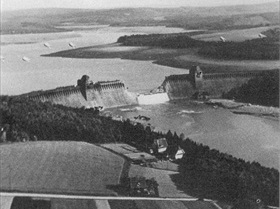
Left: The Moehne dam breached, photographed by an RAF pilot on May 17, 1943, one day after RAF 617 Squadron had attacked the dam with their cylindrical bombs. Six barrage balloons can be seen above the dam. The two direct hits on the concrete-and-steel gravity Moehne dam resulted in a breach around 250 ft wide and 292 ft deep. A torrent of water around 32‑1/2 ft high and traveling at around 15 mph swept through the valleys of the Moehne and Ruhr rivers in North Rhine-Westphalia, extending for around 50 miles from the source.
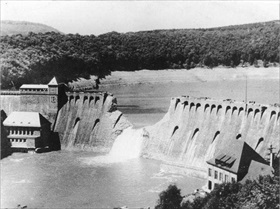
Right: The Eder dam, the largest in Europe, was also breached in two places. The wave from the breach was not strong enough to result in significant damage by the time it reached Kassel, the largest city in northern Hessen. The crest of a third dam, the Sorpe dam, had a portion been blown off but was otherwise unscathed, protected from the Lancasters by an increasingly dense fog that rolled in during the raid.
The Dambuster Raids: Operation Chastise, a Documentary

World War II was the single most devastating and horrific event in the history of the world, causing the death of some 70 million people, reshaping the political map of the twentieth century and ushering in a new era of world history. Every day The Daily Chronicles brings you a new story from the annals of World War II with a vision to preserve the memory of those who suffered in the greatest military conflict the world has ever seen.