

BRITISH TEST EXPERIMENTAL WEAPONS FOR POTENTIAL
On an English Beach · September 7, 1943
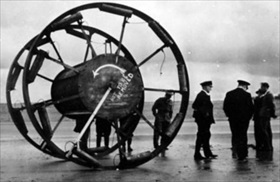
On this date in 1943, on a popular beach near a seaside village in Southwestern England, the British military not so secretly tested a giant rocket-propelled, explosive-laden contraption called the Panjandrum, known also as The Great Panjandrum. The highly experimental vehicle consisted of a pair of 10‑ft-/3‑m-high steel tread wooden wheels mounted on an axle. Its purpose was to breach Adolf Hitler’s Atlantic Wall defenses in Northern France, thereby permitting an amphibious landing force to successfully stake out a beachhead during Operation Overlord, the battle to liberate Europe from the scourge of the Third Reich. To that end each vehicle was designed to carry a 2,200‑lb/1,000‑kg package of explosives in the wheel’s hub. The vehicle would storm across the invasion beaches, detonate on hard impact against concrete or wooden beach defenses, and blast a tank-sized breach in such a wall.
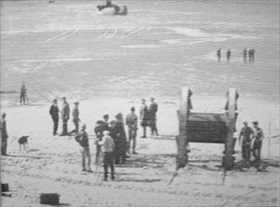
In August 1943 construction of a prototype began in East London. Within a month the prototype was ready for testing in a beach setting. On the day of the test, the 18‑rocket vehicle catapulted out of the landing craft used as a launch pad and trundled a short way up the sandy terrain, chased by a dog no less, before a number of the rockets on the right wheel failed and the weapon careered off course. Several more trials were conducted as late as January 1944, during which the vehicle, augmented by more rockets, a set of steering cables, and in one test a third wheel, sometimes fell dangerously on its side, cordite rockets exploding or breaking off and flying in all directions, terrifying the VIP spectators.
The Panjandrum never made it up the beach or, fortunately, into battle. Other, equally experimental weapons managed to pass muster and enter the Allied armed services, including two antisubmarine mortars, the Hedgehog and the Squid. Squid salvos proved so effective in crushing the hulls of enemy submarines that the weapon system was still in use by Royal Navy as late as April 1977.
Wartime Research: Some Experimental Weapons Passed Muster and Entered Service, Some Didn’t
 |
 |
Left: The British Admiralty’s Department of Miscellaneous Weapons Development (DMWD) was responsible for a number of devices of varying practicality and success. Their output encompassed both resounding successes and sublimely comical failures. Among the latter was the Great Panjandrum rocket-propelled beach defense demolition weapon shown here.
Right: The Great Panjandrum, or simply Panjandrum, revolved using propulsion from rockets arranged around its circumference. Sadly, tests in the months before the invasion revealed the weapon was too unstable, repeatedly careering off course as its rockets misfired and it hit bumps and small craters in the beach at its North Devon testing ground.
 |
 |
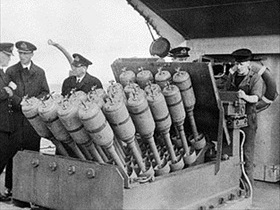
Left: The Department of Miscellaneous Weapons Development also developed successful and important weapons. The Hedgehog antisubmarine weapon was a ship-mounted 24‑barreled mortar. It was deployed on convoy-escort warships such as destroyers to supplement the depth charge. The weapon fired a number of small spigot mortar bombs from spiked fittings up to 280 yards/256 m from the ship. The 30- to 35‑lb/14- to 16‑kg bombs exploded on contact rather than using a time or depth fuse as depth charges did. They achieved a higher kill rate against submarines than conventional depth charges did.
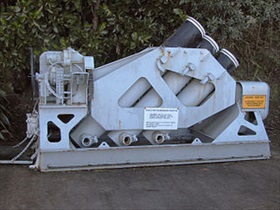
Right: Another DMWD success story was the Squid antisubmarine mortar. It replaced the Hedgehog. The Squid consisted of a 3‑barreled mortar that launched depth charges up to 275 yards/251 m ahead of the ship. Carrying a 207‑lb/94‑kg charge, the weapon was automatically fired in a triangular pattern from the sonar range recorder at the proper moment. The Squid’s first successful use was on July 31, 1944, when a British frigate sank U‑333 in the North Atlantic, followed on August 6, 1944, with killing U‑736 in the Bay of Biscay west of St. Nazaire, France. The Squid system, 9 times more effective than conventional depth charges, was credited with sinking 17 German submarines in 50 attacks.
 |
 |
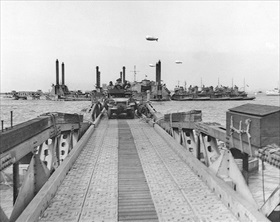
Left: Mulberry “A” pontoon causeway with supply truck. The DMWD played an instrumental role in developing parts of the 2 artificial Mulberry harbors used in the D‑Day landings. By June 9, 1944, just 3 days after D‑Day, Mulberry “A” and “B” harbors were constructed at Omaha and Gold beaches, the American and British invasion beaches, respectively.
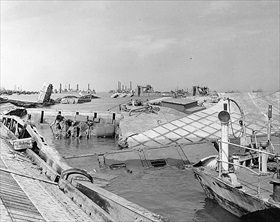
Right: Wrecked Mulberry “A” pontoon causeway, the result of a huge three‑day gale on June 19–22, 1944. The gale, the worst in 40 years, destroyed the Mulberry harbor at Omaha Beach before the whole of the breakwater had been laid, leaving only the British harbor at Gold Beach still intact. Mulberry “B” came to be known as Port Winston, named after British Prime Minister Winston Churchill. Port Winston saw heavy use for 8 months—despite being designed to last only 3 months. In the 10 months after D‑Day, it was used to land 4 million tons of supplies (its initial raison d’être), over 2.5 million men, and 500,000 vehicles, providing much-needed reinforcements in France. The captured Belgian port of Antwerp eliminated the need to maintain Port Winston.
Experimental British Weapons of World War II

World War II was the single most devastating and horrific event in the history of the world, causing the death of some 70 million people, reshaping the political map of the twentieth century and ushering in a new era of world history. Every day The Daily Chronicles brings you a new story from the annals of World War II with a vision to preserve the memory of those who suffered in the greatest military conflict the world has ever seen.