

BRIEF HALT IN ATLANTIC U-BOAT WAR
Berlin, Germany · May 24, 1943
In June 1942 German submarines sank 637,000 tons of British shipping—a greater total than in any previous or subsequent month. So many prowling U‑boats made it hard for merchant convoys sailing in the major trans-Atlantic traffic lanes to evade detection. The next year, in March, Atlantic U‑boats sank 82 ships (476,000 tons) out of 120 ships sunk worldwide; U-boat losses were 12. In April 1943 U‑boat losses climbed to 15 vs. 39 Allied kills (235,000 tons). In May 1943 U-boat numbers reached a peak, with 240 U‑boats operational, of which 118 were at sea. But on this date in 1943, after losing 43 U‑boats in convoy battles with escort ships (18 U‑boats), ship- and shore-based air patrols (21 boats), and accidents—representing a fifth of his fleet during “Black May”—Grand Admiral Karl Doenitz, commander-in-chief of the Kriegsmarine, withdrew almost all U‑boats from the North Atlantic. He is reputed to have said, “We have lost the Battle of the Atlantic.” U‑boats returned to the Atlantic during the last four months of 1943, but they never regained their former dominance, stymied in part by the loss of experienced crews but even more so by the Allies’ increasingly sophisticated antisubmarine weaponry. Technological advances progressively introduced in the 45 months since the start of the war came to fruition in May 1943 with devastating results. At this stage in the anti-U‑boat campaign, the technological advances reduced the significance of the remarkable achievements the Allies had made in unlocking the secrets of the German naval Enigma coding/decoding machine and using the resulting intelligence to huge advantage. (Ultra, as the intelligence was called, had the very practical benefit of allowing Allied convoys to evade U‑boat patrols, plus it guided hunter-killer forces to the location of U‑boats at sea.) The Germans lost the technological race to new weapons such as the multihead, contact-fused Hedgehog. A sonar-equipped ship could tail a U‑boat and lob Hedgehog mortars over its bow; the Squid could be fired forward or to the side. Together these weapons raised the percentage of kills by surface ships from 1.6 percent for conventional depth charges to nearly 20 percent, the success rates rising over time. By D-Day, June 6, 1944, the date the Allies returned to France, U‑boats had become irrelevant to the outcome of the war.
[fblike]
[amazon_carousel widget_type=”ASINList” width=”600″ height=”200″ title=”Recommended Reading” market_place=”US” shuffle_products=”False” show_border=”False” asin=”046502873X,1591143047,1848327013,1400067618,0752461885,0465091563,1848844786,1628737271,1909609374,1932033432″ /]
Important Allied Technological Advances in Antisubmarine Warfare
 |
 |
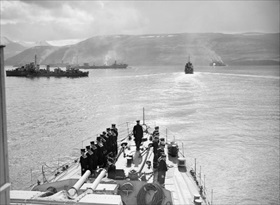
Left: Escorts and merchant ships of Convoy PQ‑17 at Hvalfjord (Hvalfjörður), Iceland, before sailing north to the ports of Murmansk and Archangel in July 1942. The route was the shortest for sending supplies to the Soviet Union, but it was also the most dangerous due to large concentrations of German U‑boats and planes in occupied Norway. PQ‑17 was decimated during a series of heavy enemy daylight attacks that lasted a week, losing 24 of its 35 merchant ships. Just eleven months later, Doenitz withdrew his U‑boats temporarily from the North Atlantic, attributing the majority of his May 1943 losses to the “superiority of enemy location instruments and the surprise from the air which is possible because of that.”
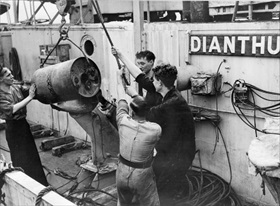
Right: An antisubmarine Mk VII depth charge being loaded onto a Mk IV depth charge thrower on board the Flower-class corvette HMS Dianthus. Most Mk VII depth charges used conventional explosives and a fuse set to go off at a preselected depth in the ocean.
 |
 |
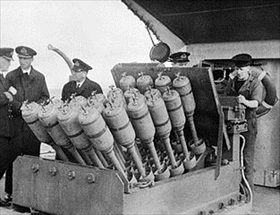
Left: The Hedgehog was a 24-barreled antisubmarine mortar mounted near the bow of a ship. The Hedgehog fired contact-fused bombs ahead of the ship when the target was within sonar (ASDIC) range. Unlike depth charges, which were launched behind and to the sides of the attacking ship, disturbing the water and making it hard to track the target because sonar contact was interrupted, Hedgehog charges exploded only on impact. Hedgehogs allowed the attacking ship to change course and maintain contact as the target maneuvered to avoid its pursuer.
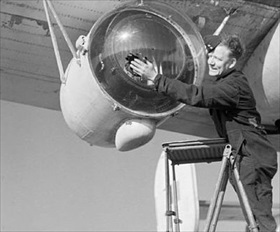
Right: A powerful searchlight, the British Leigh light was automatically aligned with an aircraft’s radar to illuminate targets on the ocean’s surface in the final stages of an attack run. A mile or so from the target, the searchlight would automatically come on, giving the target a five-second warning before it was hit by depth charges. Owing to the introduction of this device in June 1942, Allied monthly shipping losses dropped from 600,000 to 200,000 tons.
Black May, 1943: Beginning of the End of the U‑Boat Scourge

World War II was the single most devastating and horrific event in the history of the world, causing the death of some 70 million people, reshaping the political map of the twentieth century and ushering in a new era of world history. Every day The Daily Chronicles brings you a new story from the annals of World War II with a vision to preserve the memory of those who suffered in the greatest military conflict the world has ever seen.