

BOMBERS BLAST VIENNA OIL REFINERIES
Foggia Airfield Complex, Southeast Italy • June 16, 1944
On this date in 1944 nearly 600 B‑17 Flying Fortresses and B‑24 Liberators from the U.S. Fifteenth Air Force took off from bases in Foggia, Southeastern Italy, to attack oil refineries around Vienna, Austria, and Bratislava, Czechoslovakia. After Romania, Austria was the biggest Axis crude oil producer, sending half its crude to local oil refineries and the other half to refineries in neighboring Czechoslovakia and Hungary. Austria’s oil refinery at Floridsdorf, on the northern edge of Vienna, had been targeted almost 3 months earlier, when U.S. heavy bombers carried out their first attack on Austrian soil. On this date B‑17s targeted the Floridsdorf and nearby Kagran oil refineries, while B‑24s struck oil refineries at Lobau, west of Vienna, Schwechat, southeast of Vienna, and the Apollo oil refinery at Bratislava. Ten days later and again in August bombers revisited Floridsdorf, Lobau, and Schwechat.
Elsewhere in Germany and Nazi-occupied territories, the Fifteenth and Eighth Air Forces hammered Axis petroleum facilities so badly that Nazi Armaments Minister Albert Speer (pronounced “spare”) told Adolf Hitler in the summer of 1944 that Germany’s aviation gasoline production had been severely compromised in May and June. If the Third Reich could not protect its refineries and hydrogenation factories by all available means, it would be impossible to get them back into working order from the state they were in. He predicted if it came to that, “by September we shall no longer be capable of covering the Wehrmacht’s most urgent needs.”
Speer’s lamentations would have been music to the ears of Gen. Carl Spaatz, head of U.S. strategic air forces in Europe, had he heard them. On D-Day, June 6, 1944, Spaatz said that the primary aim of the Eighth and Fifteenth Air Forces was to deny oil to the enemy. Between September, the critical month Speer had mentioned in his talk with Hitler, and January 1945, oil targets, including oil storage depots, plants producing synthetic oil from coal, and pumping stations, became the air force’s highest priority. Writing in 1970, Speer said that the Allied oil campaign “meant the end of German armaments production.” Luftwaffe general and flying ace Adolf Galland reminisced that the Allied oil campaign was “the most important of the combined factors which brought about the collapse of Germany.”
Stephen Ambrose’s The Wild Blue: The Men and Boys Who Flew the B-24s Over Germany is an excellent account of the U.S. Eighth and Fifteenth Air Forces tethered to the aircrew led by a twenty-two-year-old pilot from the American Midwest named George McGovern. (McGovern later became a United States senator and a presidential candidate.) Ambrose’s gift for weaving real persons into his story-telling is evident here again as he recounts the bravery, skill, daring, and comradeship of McGovern’s 741st Squadron of the Fifteenth’s 455th Bomb Group, a stand-in for just about every other heavy-bomber squadron and bomb group in any of the Army Air Forces. In acquainting us with the pilots, co-pilots, bombardiers, navigators, gunners, ground crews, operations officers, and group commanders of the Fifteenth Air Force—Ambrose devotes substantial text to developing their personal stories—I gained a deep appreciation of the spirit and grit that characterized these young U.S. airmen (mostly in their early twenties but some still in their teens) who were just as likely to not survive as survive their twenty-five, then thirty-five bombing missions over enemy territory. (On average, close to four percent of the bomber force was killed or missing in action on each mission.) One segment of the “greatest generation” to which these airmen belonged is superbly told in Ambrose’s The Wild Blue.—Norm Haskett
Operation Tidal Wave: Attacking Romania’s Ploiești (Ploesti) Oil Complex, August 1, 1943
 |
 |
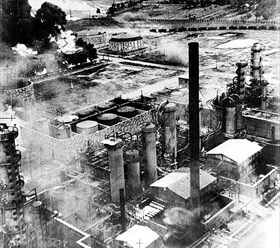
Left: In 1943, crude and refined oil from Romania’s Ploiești (Ploesti) oil fields provided about 35 percent of all Axis oil supplies, five times what runner-up Austria provided, and furnished 90 percent of the Luftwaffe’s aviation fuel needs. Strategic planners, military specialists, and oil-refining authorities concluded that the destruction of the Axis oil industry held the key to the Luftwaffe’s defeat and Germany’s as well. In this photo oil storage tanks at the Columbia Aquila refinery, 1 of 11 in the Ploiești refinery complex, burn after the raid by Libyan-based B‑24 long-range bombers of the U.S. Ninth Air Force, assisted by Liberators from the Eighth Air Force based in England. The distance flown by the bombers set a record for aerial warfare broken only in 1944 in the Pacific Theater.
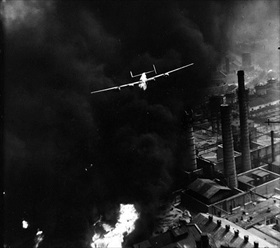
Right: Equipped with special low-altitude bombsights, B‑24 Liberators flew low (less than 500 ft./154 m off the ground) as they approached Ploiești’s oil refineries to avoid detection by German radar. The heavy bombers dropped some 300 tons of high-explosive, mostly delayed-action bombs, as well as clusters of incendiaries by the hundreds. This iconic image, one of the most famous of World War II, shows The Sandman, piloted by Robert Sternfels, as it emerges from a pall of smoke, barely clearing the stacks of Astra Romana refinery, the largest of Ploiești’s refineries.
 |
 |
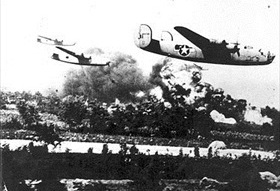
Left: Liberators flew into the mouth of Ploiești’s defenses, which included several hundred 88 mm (3.46 in. and 105 mm (4.1 in.) antiaircraft guns. Many more small-caliber guns were concealed in haystacks, railcars, and mock buildings. In addition the Luftwaffe had 3 fighter groups within flight range of Ploiești, assisted by some Romanian fighter aircraft.
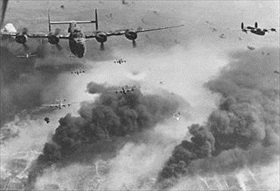
Right: Despite months of planning, preparation, training, and practice, the August 1, 1943, mission over Ploiești was one of the costliest for the USAAF in the European Theater: 53 aircraft and 660 out of 2,000 airmen were lost. Only 88 B‑24s of the original 178 aircraft returned to Libya. Some landed in neutral Turkey, where the airmen were interned, and some landed at an RAF airfield on Cyprus. August 1 was later referred to as “Black Sunday.” Sadly for the Allies, within weeks most of the damage to the refineries had been repaired, and the net output of fuel was greater than before the raid.
1943 Newsreel Includes Scenes from Ploiești, Churchill’s Visit to North America, Building Liberty Ships, Navy Men on Leave, and Patton in Sicily

World War II was the single most devastating and horrific event in the history of the world, causing the death of some 70 million people, reshaping the political map of the twentieth century and ushering in a new era of world history. Every day The Daily Chronicles brings you a new story from the annals of World War II with a vision to preserve the memory of those who suffered in the greatest military conflict the world has ever seen.