

BLOODBATH IN GERMAN CAPITAL, OTHER CITIES
Berlin, Germany · June 29, 1934
Late on this date in 1934 German Chancellor Adolf Hitler unleashed an extraordinary murder spree known as the Night of the Long Knives (Nacht der Langen Messer). President Paul von Hindenburg’s doctors had leaked the news that the 86-year-old German war hero had only months to live. Hitler feared that senior leaders in the Reichswehr (German army) would push hard for a return of the former Hohenzollern monarchy, which ended with the abdication of Kaiser Wilhelm II following Germany’s defeat in World War I. Therefore, Hitler devised a plan to keep the generals from acting against him or his brownshirt SA thugs in the Sturmabteilung (“storm troopers”). The SA was a paramilitary “citizens’ army” led by long-time friend SA-Fuehrer Ernst Roehm, whom the generals saw as commanding a competing force to theirs. Thus, on this night and extending to July 2 hundreds of mostly SA men were butchered (along with the occasional wife); some were dragged out of their beds and shot, while others were killed by firing squads. Roehm was disposed of in his prison cell, shot dead after refusing to commit suicide. Hitler’s press chief later opined that “the monstrous side of Hitler’s nature for the first time broke loose and showed itself for what it was.” When the purge was complete, Hitler cynically claimed in a speech to the German parliament, the Reichstag, in mid-July that he had saved the nation from a Roehm putsch and furthermore that in the future everyone should know that if one raises his hand against the State, then certain death is his lot. As for saving the country from a coup d’état—that stretched the truth. After the massacre, the army old guard, ignorant of the details of the purge, lined up behind Hitler. Even President Hindenburg praised Hitler for taking swift action against the “traitors”—which is what Hitler called his enemies in the Nazi Party. But within Germany and abroad, commentators reacted with amazement and even panic. From his exile in Holland, the former Kaiser was deeply appalled by the bloodletting: “What would people have said if I had done such a thing?” he asked. Future Axis partner Benito Mussolini wrote his sister: “Look at how vicious this man can be! Some terrible names from history come to mind: a new Attila? And he killed some of his closest colleagues.”
[fblike]
[amazon_carousel widget_type=”ASINList” width=”600″ height=”200″ title=”Recommended Reading” market_place=”US” shuffle_products=”False” show_border=”False” asin=”030740885X,143919100X,0786477296,0801870569,1599210703,0306807602,1602399727,1845456807,1425102476,0230120504″ /]
Night of the Long Knives, June 29 to July 2, 1934
 |
 |
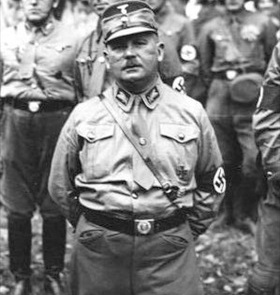
Left: Ernst Roehm in Bavaria in February 1933, sixteen months before his murder. Roehm (1887–1934) was one of the earliest members of the Nazi Party and had participated in Hitler’s failed Beer Hall Putsch in late 1923. The “Roehm Putsch” eleven years later was a fiction created by Hitler and his closest associates to win over the Reichswehr, powerful industrialists, aristocrats, landowners, and liberal bourgeoisie who were critical of a national militia with millions of members who engaged in violence and hooliganism. Also, Roehm’s homosexuality did not endear him to conservatives. In June 1934, their demands that Hitler act against the SA came to a grisly head. Probably more than 1,000 lost their lives in the well-planned orgy of arrest, assassination, and execution.
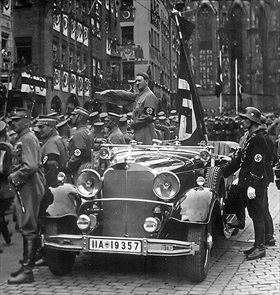
Right: Storm troopers parade past Hitler in Nuremberg, September 1935. Membership in the Sturmabteilung plummeted from 2.9 million in August 1934 to 1.2 million in April 1938. The Night of the Long Knives—the term was coined by Hitler himself—represented a triumph for the Nazi leader, as well as a turning point for Germany. It established Hitler as “the supreme judge of the German people,” as he explained to Reichstag members on July 13, 1934. Centuries of German jurisprudence proscribing extrajudicial killings were swept away, replaced by a pattern of violence that characterized the Nazi regime as long as it lasted.
Night of the Long Knives Unleashes Horror and Chaos

World War II was the single most devastating and horrific event in the history of the world, causing the death of some 70 million people, reshaping the political map of the twentieth century and ushering in a new era of world history. Every day The Daily Chronicles brings you a new story from the annals of World War II with a vision to preserve the memory of those who suffered in the greatest military conflict the world has ever seen.