

AXIS FORTUNES RECOVER IN BALKANS
Belgrade, Yugoslavia • April 6, 1941
At the tail end of February 1941 British Commonwealth forces from Nigeria captured Mogadishu, capital of Italian Somaliland (part of today’s Somalia), after Benito Mussolini’s armies had abandoned any pretense of defending their East African colony. The Italian colony in the Horn of Africa, which in August 1940 absorbed neighboring British Somaliland, had threatened the southern entrance to the Suez Canal in Egypt as well as the Middle Eastern oil fields and the British sea route to India.
On this date, April 6, 1941, two days after it was abandoned by the Italians, the Ethiopian capital of Addis Ababa was occupied by the British Army’s 11th (African) Division composed primarily of colonial troops from East and West Africa. Addis Ababa thus earned the distinction of being the first national capital liberated from the Axis. Italian forces capitulated in Eritrea, Ethiopia’s northern neighbor facing the Red Sea, in a separate campaign later that month. Mopping up operations continued until November 1941, when all of Italian East Africa (Africa Orientale Italiana) fell under Allied control.
Meanwhile, in Southeastern Europe the Balkans weighed heavily on the minds of Mussolini and his Axis partner, Adolf Hitler. The Duce’s armies, having invaded Greece in late October 1940 from Italian-held Albania, which lay north of Greece, were faring poorly against Greek defenders. (The vainglorious Italian dictator struggled miserably to duplicate on the east side of the Adriatic Sea Hitler’s swift takedown of the Low Countries and France in Western Europe earlier that year.) Should Italy fail after Hitler had rushed 50,000 German troops to bolster Italy’s position in the Balkans, the Greeks might permit Great Britain to base troops on their soil—already 60,000 British and Commonwealth troops from Northwest Africa had rushed to Greece’s aid—thereby potentially complicating Operation Barbarossa, Hitler’s colossal summer campaign against the Soviet Union.
So against the backdrop of Axis losses in East Africa, Axis armies from Hungary, Romania, and Bulgaria, spearheaded by 33 German divisions and supported by 1,200 aircraft of the Luftwaffe, swept across the frontier into Yugoslavia and Greece on April 6, 1941, bringing both nations into the Axis orbit and forcing Allied troops into a painful Dunkirk-like evacuation of the Greek mainland. By April 29, 1941, the Allied presence was gone with the exception of 12,000 servicemen who had been swept into German captivity. North of Greece, portions of Yugoslavia were placed under Axis occupation, annexed by Italy (Central Dalmatia and part of Slovenia), or formed into a new Fascist state, Croatia.
Three and a half years later, in October 1944, the Germans were forced to abandon Greece, the same month they abandoned Yugoslavia. Hundreds of thousands of Greeks died during the Nazi years along with a million Yugoslavs, although most of the latter died at the hands of rival partisan groups.
Scenes from the German Balkans Campaign, April 1941
 |
 |
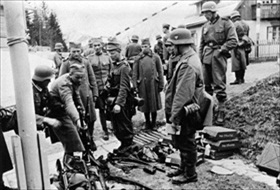
Left: Starting on April 6, 1941, Axis armies invaded Yugoslavia from all sides. This photo shows a Yugoslav infantry unit surrendering on the first day of war.
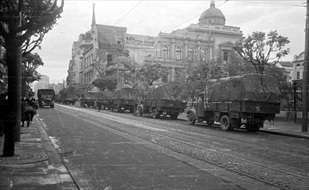
Right: Operation Punishment, aka Operation Retribution Unternehmen Strafgericht), was the code name for the German bombing of Belgrade, Yugoslavia’s capital, which began on April 6, 1941 (Palm Sunday), and continued through April 10. In instructions to the Luftwaffe Hitler had specifically ordered “the city of Belgrade be destroyed from the air by continual day and night attack.” Among the chief bombing targets was the Yugoslav royal palace of King Peter II (seen here) in downtown Belgrade. Other targets included the war ministry, military headquarters and barracks, the central post and telegraph office, electrical power stations, and railway passenger and freight stations. The aerial attacks resulted in the paralysis of Yugoslav civilian and military command and control and the widespread destruction of Belgrade’s infrastructure. As much as 50 percent of the city’s housing was destroyed and as many as 17,000 residents killed, although a figure between 3,000 and 4,000 is more realistic.
 |
 |
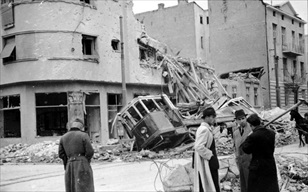
Left: A street damaged by the Luftwaffe’s bombing of Belgrade, April 1941. German Field Marshal Paul von Kleist said during the postwar Nuremberg Trials: “The air raid on Belgrade in 1941 had a primarily political-terrorist character and had nothing to do with the war. That air bombing was a matter of Hitler’s vanity, his personal revenge,” on the Yugoslav officers who overthrew Yugoslavia’s pro-Axis regent, Prince Paul. Luftwaffe Col. Gen. Alexander Loehr, who selected the targets his airmen attacked in the capital, was caught and tried before a postwar Yugoslav military court on multiple war crimes charges. He was convicted, condemned to death, and executed by firing squad on February 26, 1947, in Belgrade.
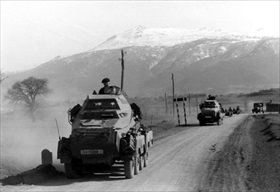
Right: Armored cars of the 1st SS Division Leibstandarte SS Adolf Hitler advance into Greece during Operation Marita (Unternehmen Marita), April 6–30, 1941.
 |
 |
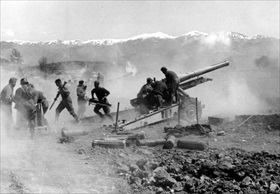
Left: German artillery firing during the advance into Greece, April 1941.
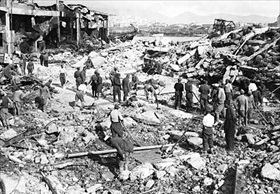
Right: Damage from the German bombing of Piraeus, Athens’ harbor, on April 6, 1941. During the bombing, a ship carrying nitroglycerin was hit, causing a huge explosion. The Battle for Greece was costly, especially for the Italians (13,755 dead, 63,142 wounded, and 25,067 missing) as contrasted with German casualties of 1,099 dead, 3,752 wounded, and 385 missing. On the Allied side, the Greeks counted 57,183 casualties, among them 13,408 dead, and British and Commonwealth units over 900 dead, 1,250 wounded, and nearly 14,000 captured.
Axis Invasion of Greece and Yugoslavia in World War II

World War II was the single most devastating and horrific event in the history of the world, causing the death of some 70 million people, reshaping the political map of the twentieth century and ushering in a new era of world history. Every day The Daily Chronicles brings you a new story from the annals of World War II with a vision to preserve the memory of those who suffered in the greatest military conflict the world has ever seen.