

AVRO LANCASTER HEAVY BOMBER MAKES MAIDEN FLIGHT
RAF Ringway, Manchester, England • January 9, 1941
On this date in 1941 a prototype 4-engine heavy bomber took off from RAF Ringway in the English county of Cheshire on its maiden flight. Designed by Avro—an initialism of the company’s founder Alliott Verdon-Roe—the best-known British bomber of World War II was named after the historic county of Lancaster. Avro’s Lancasters were produced chiefly at Chadderton north of the city of Manchester in the industrial northwest of England and hauled in sections south 20 miles/32 km to Woodford Aerodrome, where they were assembled and flight tested. But the iconic 29‑ton airplanes came close to never being built.
The first production model, the Lancaster B.I, had its origins in the smaller twin-engine bomber Avro Manchester, which had been developed in the mid‑to‑late 1930s when medium bombers like the Heinkel 111, the Junkers Ju 86, and the Dornier D 17 were entering service in Nazi Germany, the Fiat BR.20 Cicogna and Savoia-Marchetti SM.81 Pipistrello in Fascist Italy, and the Tupolev SB‑2 in the Soviet Union. The Germans, Italians, and Soviets put their twin-engine bombers through bloodthirsty trials during the Spanish Civil War (1936–1939).
Entering service with the Royal Air Force in November 1940, a little over a year after Great Britain and France had declared war on Germany and Italy, the Avro Manchester (202 were built) came to be regarded as an operational failure due primarily to its underpowered and unreliable Rolls-Royce Vulture engines. Not only did Avro engineers switch out Vulture engines in favor of Rolls-Royce Merlins, they redesigned the Manchester as a 4‑engine heavy bomber with lengthened wingspan and airframe while keeping the signature 3‑finned tail for directional stability. (The middle fin was dropped in the second prototype.) The new Lancasters—or “Lancs” as they were colloquially called—were powerful, bristled with 7.7 mm Browning Mark II machine guns in the nose, mid-upper (dorsal), and rear turrets, and were capable of carrying in their unobstructed, 33 ft/10 m-long bomb bays an enormous bombload, particularly later in the war when increasingly large and specialized bombs like the deep-penetration “Tallboy” and then “Grand Slam” were made available.
The Lancaster B.I entered RAF service in February 1942 and conducted its first operational sortie on March 2, 1942. Just over a week later a small number of Lancs took part in a raid on Essen, Germany, and at the end of May 76 Lancs took part in the RAF’s first 1,000‑bomber raid on nearby Cologne. More Lancs quickly rolled off the production lines (Avro’s and 5 licensees’, 1 of them in Canada). RAF squadrons flying problem-plagued Manchesters and the RAF’s other, less-capable twin-engine medium bombers, such as the Armstrong Whitworth Whitley, Handley Page Hampden, Vickers Wellington, all entering service in 1936–1938, and even the 4‑engine heavy bomber Short Stirling, which entered service in 1941, saw their warbird pens backfilled with Lancs.
The Lancaster became the most numerous 4‑engine “heavy” in Britain’s Bomber Command’s inventory, with nearly half the 7,377 Lancs manufactured for the war effort built by Avro, the rest by licensees. More than 920 companies produced subcomponents for the production and assembly lines. At full employment roughly 1.1 million men and women were engaged in making parts for or assembling the aircraft. More people were involved in building, maintaining, and flying Lancaster bombers than any other RAF aircraft, before or since. Indeed, the initial version of the Lancaster, the B.I, stayed in production or was converted for other uses such as air-sea rescue and general and maritime reconnaissance well after the war.
British and U.S. Heavy Bombers During World War II
 |
 |
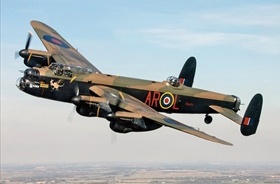
Left: Flying above Lincolnshire, England, this vintage Avro Lancaster wears camouflage paint and markings of No. 460 Squadron Royal Australian Air Force. The Lancaster workhorse had an impressive combat record. It sortied approximately 156,000 missions, including several that dropped the 22,000 lb/10,000 kg Grand Slam “Earthquake” bomb after bulged bomb bay doors had been added to 30 percent of the Lancaster fleet. Depending on the distance of the mission, a Lancaster typically carried between 8,000 lb/3,629 kg and later 12,000 lb/5,443 kg of high-explosive (HE), incendiary, and semi-armor-piercing (SAP) bombs, the latter used against submarines up to 1942. Because the Lancaster’s design and structure were so sound, the aircraft was evolved into the Lincoln bomber (operational from August 1945 on) and later the Shackleton (marine patrol aircraft using parachute-deployed magnetic or acoustic mines), which remained in service into 1991. During the war 3,736 Lancasters were lost in action (3,249) and ground accidents (437)—in other words 44 percent of all Lancasters produced.
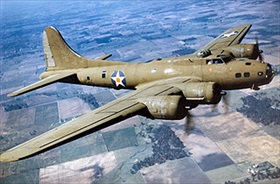
Right: By the time the U.S. entered World War II in December 1941 the Boeing B‑17 Flying Fortress was outdated based as it was on 1920s-early 1930s technology. Some 12,731 B‑17s were produced between 1936 and 1945. First flown in combat by the Royal Air Force over Europe, the British found the B‑17’s performance dismal and preferred flying the Consolidated B‑24/LB‑30 Liberator. B‑17s flew with the U.S., British, and Soviet air forces. The German Luftwaffe even flew a dozen captured ones. Flying Fortresses were armed with 13 .50 caliber/12.7 mm M2 Browning machine guns in 8 positions. Depending on the distance of the mission, a B‑17 could carry between 4,000 and 8,000 lb/1,814 and 3,629 kg of bombs. (Loaded with a 6,000 lb/2,722 kg bombload, it had a range of 2,000 miles/3,219 km.) More bombs were dropped by B‑17s than by any other U.S. aircraft in World War II. Of the 1.5 million metric tons of bombs dropped on Nazi Germany and its occupied territories by U.S. aircraft, 640,000 tons were dropped from B‑17s. During the war more than 5,000 B‑17s were shot down by German fighter planes or flak batteries—in other words, nearly 40 percent of all B‑17s produced.
 |
 |
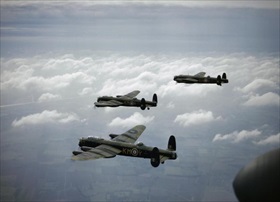
Left: Three RAF Avro Lancaster B.I Specials based at Waddington, Lincolnshire, fly above the clouds, September 29, 1942. Introduced into service in February 1942, Lancasters became the main heavy bomber used by the RAF as well as the most famous and successful of the war’s night bombers in contrast to the USAAF heavy bombers that were used mostly in daylight raids over occupied Europe. On the night May 16, 1943, a British squadron of 19 modified Avro Lancaster bombers (B.III Specials), each with a 9,250‑lb/4,196‑kg payload of 1 externally mounted, specially designed “Upkeep” bouncing bomb (actually a 5 x 4 ft [1.5 x 1.2 m] drum-shaped depth charge rotating at 500 rpm), flew toward 3 dams on the Moehne and Eder rivers in the Germany’s Ruhr Valley in the state of North Rhine-Westphalia. In a spectacular feat of precision bombing under heavy ground fire, the “dambusters” in Operation Chastise arguably performed the most audacious bombing raid of the European war, breaching 2 of 3 targeted dams as 12 surviving Lancs flew 60 ft/18 m above the reservoirs’ surface at 220 mph/354 km/h. The Moehne dam alone spilled around 330 million tons of water into the western Ruhr region, devastating factories, munition plants, power stations, railway and road bridges, homes, mines, and farmland for miles/kilometers around. Bodies of at least 1,579 victims, many of them prisoners in forced labor camps, were found along the Moehne and Ruhr rivers, 70 in the Eder Valley, with hundreds of people gone missing. The RAF lost 8 Lancasters and 53 airmen (close to half of No. 617 Squadron’s courageous crewmembers) in the Chastise raid.
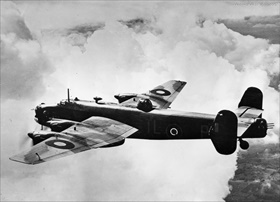
Right: Squadron No. 35 was the first RAF squadron to use the Handley Page Halifax pictured above. The Halifax entered military service in November 1940. Squadron No. 35 carried out the first Halifax raid on March 10/11, 1941, over Le Havre, France. Both the Avro Lancaster (left frame) and the Halifax emerged as capable 4‑engine strategic bombers. Air Chief Marshal Sir Arthur Harris, since February 1942 head of RAF Bomber Command, deprecated the Halifax for its smaller payload, sharing as it did the same specification as the contemporary twin-engine Avro Manchester. Halifax’s stable mate Lancaster had the distinction of carrying the 22,000 lb/9,979 kg earthquake bomb called Grand Slam used by Bomber Command against hardened German targets towards the end of World War II. During their wartime service Halifaxes flew a total of 82,773 operations and dropped 224,207 tons of bombs, while 1,833 aircraft were lost. The Halifax was flown in large numbers by other Allied and Commonwealth air forces such as Canada’s, Australia’s, the Free French, and Poland’s.
Avro Lancaster Documentary Using Contemporary Film

World War II was the single most devastating and horrific event in the history of the world, causing the death of some 70 million people, reshaping the political map of the twentieth century and ushering in a new era of world history. Every day The Daily Chronicles brings you a new story from the annals of World War II with a vision to preserve the memory of those who suffered in the greatest military conflict the world has ever seen.