

ANTONESCU TAKES REINS OF ROMANIAN GOVERNMENT
Bucharest, Romania · September 5, 1940
In the wake of Romania’s swift territorial concessions of Bessarabia and Northern Bukovina to the Soviet Union, the northwestern part of Transylvania to Hungary, and the southern part of Dobruja to Bulgaria (see map below), 47‑year‑old King Carol II abdicated in favor of his 19‑year‑old son, Michael (Mihai), but not before appointing distinguished anti-Communist Gen. Ion Antonescu to the post of prime minister on this date in 1940. (The government in Bucharest had no way of knowing that a secret protocol to the 1939 Molotov-Ribbentrop Nonaggression Pact had “delivered” Bessarabia and Northern Bukovina to the Soviets.) Antonescu, despite opposing the German-engineered transfer of portions of Transylvania to Hungary, invited German troops to move into his country and train and rebuild the Romanian Army—and safeguard the country’s Ploiești oil fields, which had become vitally important to the Nazi war effort.
On November 23, 1940, Antonescu steered Romania into the Axis Tripartite Pact (Germany, Italy, and Japan)—with devastating consequences down the road. In the fighting around Stalingrad alone (August 1942 to February 1943), the Soviets slaughtered two Romanian armies (the Romanian Third Army and the Romanian Fourth Army). By August 1944 the Soviet conquest of Romania had become inevitable. Toward the end of that month, after the Axis front in Northeastern Romania collapsed under the Soviet offensive, King Michael joined with pro-Allied politicians, a number of Army officers, and armed Communist-led civilians in staging a successful coup against the pro-German Romanian faction of Ion Antonescu.
Despite German efforts to restore Antonescu, the coup effectively amounted to Romania’s capitulation and helped speed the Red Army’s advance into the country. In a radio address to the nation and Army, King Michael issued a ceasefire, proclaimed Romania’s loyalty to the Allies, and declared war on Germany. An armistice was signed on September 12, 1944, on terms the Soviets virtually dictated. Under its terms Romania was placed under occupation of the Allied forces with the Soviets, as the Allies’ representative, in control of media, post and telephone, and civil administration. In five years of war more than 281,000 Romanian combatants and noncombatants were killed, 500,000 were taken prisoner by the Soviets, and 200,000 died in captivity.
[fblike]
[amazon_carousel widget_type=”ASINList” width=”600″ height=”200″ title=”Recommended Reading” market_place=”US” shuffle_products=”False” show_border=”False” asin=”1300136618,1403993416,0393322521,0140284583,0786471697,0811733718,0140271694,1891227564,0804759863,9739839258″ /]
Romania During World War II
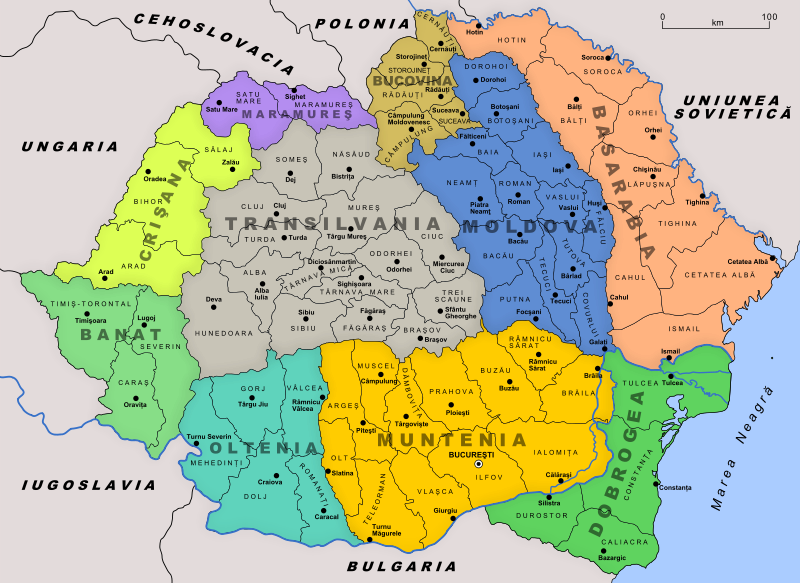 |
Above: Map of Romania in 1930. Areas ceded in June 1940 to the Soviet Union are Bessarabia (rose) and Bukovina (brown). The northern part of Transylvania (gray) reverted to Hungary on August 30, 1940. The southern part of Dobruja (Dobrogea as it appears on the map) was formally ceded to Bulgaria on September 7, 1940. That so much territory was lost without a fight shattered King Carol’s authoritarian regime.
 |
 |
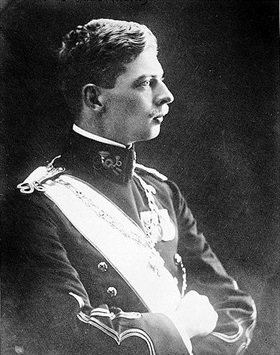
Left: King Carol II (1893–1953; reign 1930–1940). Forced under first Soviet and subsequently Hungarian, Bulgarian, and German pressure to surrender parts of his kingdom to foreign rule, authoritarian King Carol II was outmaneuvered by the pro-German, anti-Soviet faction of Gen. Ion Antonescu and abdicated in favor of his son, Michael, the once and future king.
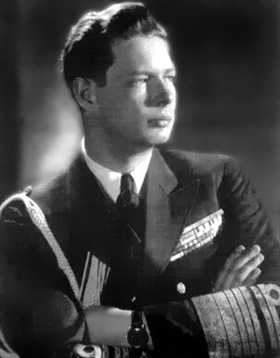
Right: King Michael I of Romania in 1947. Michael (Romanian, Mihai; born 1921) reigned from July 20, 1927, when he was a 6‑year-old, to June 8, 1930, and again from September 6, 1940, to December 30, 1947, when he was forced to abdicate by the government controlled by the Communist Party of Romania.
 |
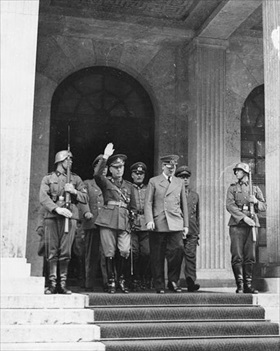 |
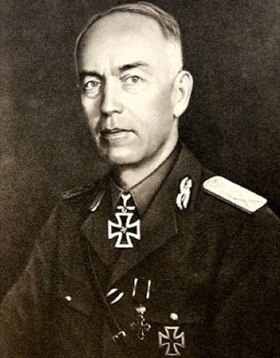
Left: Wartime photograph of Field Marshal Ion Antonescu. On September 5, 1940, Antonescu became Romania’s Prime Minister. He traveled to Germany and met Adolf Hitler on eight occasions between June 1941 and August 1944. On August 23, 1944, King Michael I arrested Antonescu. In May 1946, the Romanian Communist government prosecuted Antonescu in a series of People’s Tribunals on charges of war crimes, crimes against the peace, and treason. He was executed by a military firing squad on June 1, 1946.
Right: Hitler’s red carpet reception of Antonescu for bilateral discussions in Munich on June 10, 1941. Behind and between the two men is Field Marshal Wilhelm Keitel, Supreme Commander of the German Armed Forces. To Keitel’s left is German Foreign Minister Joachim von Ribbentrop, co-signer of the notorious 1939 Molotov-Ribbentrop Nonaggression Pact.
Antonescu’s Romanian Troops Retake Soviet-Occupied Bessarabia, June–July 1941

World War II was the single most devastating and horrific event in the history of the world, causing the death of some 70 million people, reshaping the political map of the twentieth century and ushering in a new era of world history. Every day The Daily Chronicles brings you a new story from the annals of World War II with a vision to preserve the memory of those who suffered in the greatest military conflict the world has ever seen.