

ALLIED REWARDS LIKELY FROM RADAR STATION RAID
London, England • February 27, 1942
Under the cover of darkness on this date in 1942, 119 British paratroopers kicked off Operation Biting when they parachuted into Nazi-occupied Normandy close to a German radar station in the parish (commune) of La Poterie-Cap-d’Antifer, 12 miles/19 km north of the large French harbor of Le Havre. A number of what were inferred to be ground radar installations had been identified by the Royal Air Force during aerial reconnaissance in December 1941. They looked nothing like the operational (since 1939) German early warning radar devices known as “Freya” with their tall, flat antenna arrays. However, the exact purpose and, of course, the nature of the equipment housed in these newly discovered radar installations with their paraboloid dish antennas were unknown.
Radar is short for “radio detection and ranging.” It is a system of bouncing radio waves against an object and measuring its rate of travel to determine targeting information. Though development of this new detection method had been underway for several years in the United States, Great Britain, and Germany, where Germans knew it as Dezimeter Telegraphie, or “D/T,” the British were the first to utilize it during World War II when they built a chain of land-based radar stations along the southeast coast of England north to the tip of Scotland. Within a few years radar equipment would also be installed on aircraft and ships as well.
On landing in German-occupied France, the well-armed British paratroopers quickly dispersed the few Germans at the “Wuerzburg‑A” radar site, disassembled the 10‑ft/3.6‑m dish antenna as a nearby enemy pillbox fired on them, removed and packed vital components, and left for the nearby beach at Bruneval. (The commando-type raid is sometimes known as Operation Bruneval or the Bruneval Raid.) From the beach six Royal Navy landing craft took the raiders and their liberated booty, including one German radar technician, back to England where the technology could be studied and countermeasures designed and implemented to neutralize its effectiveness. That was when British scientists discovered that all German ground-based radar systems operated on a small number of frequencies, and that the various Wuerzburg radar models could be easily jammed by air-dropping aluminum strips (variously called “window” or “snowflake”) to flutter down like a cloud, thereby swamping an operator’s radar screen with multiple returns (“blips”).
Initially British Prime Minister Winston Churchill forbade RAF Bomber Command from dropping reflecting chaff over German targets—thinking the Luftwaffe might get wise and apply the same strategy over British targets. That would of course confuse British radar operators (and antiaircraft batteries), leading to untoward consequences on the ground. He relented after several months. Operation Gomorrah, the huge and devastating Allied bombing raids on the North German port of Hamburg in late July/early August 1943, succeeded in part by air-dropping this reflecting chaff. For hours before the D-Day landings on June 6, 1944, British planes dropped tons of tinfoil strips over the German-held French coast of Normandy to confuse enemy radar operators while 7,000 Allied ships approached the invasion zones undetected. Even though Germans had pioneered its use—reflecting chaff was known as “Dueppel” in German—they did nothing to prepare themselves for its use by their foes.
The month before Operation Gomorrah, after a British photo interpreter had identified a stack of Wuerzburg dish antennas in a manufacturing yard in Friedrichshafen on Lake Constance (Southern Germany), Churchill ordered the RAF to bomb the site, which occurred on June 20, 1943 (Operation Bellicose). Notwithstanding successful Allied countermeasures like tossing tinfoil clusters from airplanes during bombing raids and the 1943 aerial assault on the radar production facility on Lake Constance, some 4,000 Wuerzburg sets of various models found their way into Wehrmacht service starting in 1941.
German Ground-Based Wuerzburg Radar Equipment
 |
 |
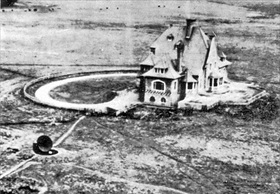
Left: RAF photo-reconnaissance picture of the Wuerzburg radar dish (dark round object lower left) adjacent to a large Victorian gingerbread villa, which Free French underground agents later confirmed contained a machine-gun emplacement, not far from the Norman village of Bruneval, early December 1941.
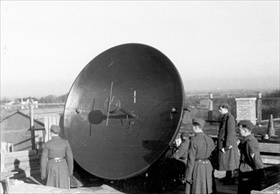
Right: A Telefunken Wuerzburg radar apparatus (Funkmessgeraet, or FuMG in German) installed on the English Channel coast, occupied France, 1943. For a cost of two dead, two wounded, and six missing out of 120 men of Company C, 2nd Parachute Battalion, the daring and successful February 1942 Bruneval raid provided British intelligence with a close-up view of the new German air defense radars: their vital components, their impressive modular design that made maintenance and troubleshooting easy even by operational staff who were ignorant of radar technology, how the radar equipment was used, on what frequencies the radar operated, and what countermeasures could be used to thwart German radar sets, all of which were crucial if Allied long-range bombers and fighter aircraft were to operate effectively over Nazi-occupied Europe.
 |
 |
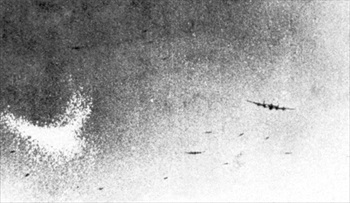
Left: An RAF Avro Lancaster dropping metallic chaff (the crescent-shaped white cloud in the left of the picture) to interfere with antiaircraft batteries during a thousand-bomber stream over Essen, Germany. No date. One benefit of the Bruneval raid was that the Allies were able to test out metallic chaff (window) sizes and jamming tactics on a genuine Wuerzburg radar array itself.
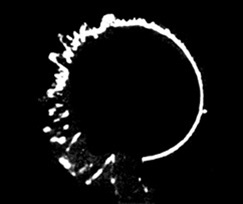
Right: The effect of chaff on the display of a Giant Wuerzburg radar scope. The effect of jamming appears in the left “jagged” half of the circular ring, contrasting with the normal “smooth” (unjammed) display on the right half of the circle, with a real target at the 3 o’clock position. On the jammed left side, the real target “blip” (an Allied aircraft) would have been indistinguishable from the chaff.
1945 Newsreel “Reveals Radar’s Secrets” (View first 3 minutes 45 seconds)

World War II was the single most devastating and horrific event in the history of the world, causing the death of some 70 million people, reshaping the political map of the twentieth century and ushering in a new era of world history. Every day The Daily Chronicles brings you a new story from the annals of World War II with a vision to preserve the memory of those who suffered in the greatest military conflict the world has ever seen.