

HITLER OPENS VOLKSWAGEN FACTORY
Fallersleben (Wolfsburg), Lower Saxony • May 26, 1938
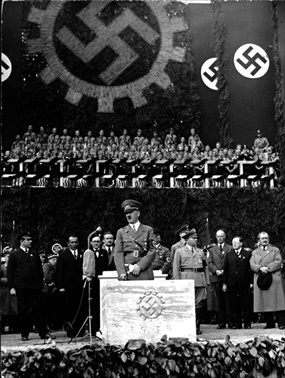
On this date in 1938 near Fallersleben in the German state of Lower Saxony, Chancellor Adolf Hitler and Nazi dignitaries laid the foundation stone for the KdF-Wagen car factory. The state-owned factory was placed under the umbrella of the Nazi Party’s German Labor Front (Deutsche Arbeitsfront, or DAF), the national labor organization that ran the “Strength Through Joy” program, or Kraft durch Freude program. The program’s initials, KdF, bequeathed the car company, its 4‑wheel product (namely, the wagen”), and the company town near Fallersleben their first names. Bombed and shelled by the Allies in World War II, the factory avoided wholesale destruction, emerging as Volkswagen (literally, “people’s car”) in what is today’s Wolfsburg. Certainly, the most famous vehicle produced by Volkswagen was its iconic Beetle, or “Bug” as it was commonly called in the United States. Production of the Beetle only halted in 2019 following manufacturing restart in 1945, the year the VW plant was transferred to the British military government. (Fallersleben and the adjacent company town, Stadt des KdF-Wagens, founded July 1, 1938, were renamed Wolfsburg to honor a nearby medieval castle. The factory, the worker settlement, and the Arbeitsdorf concentration camp were located in the British zone of Allied occupation.) On August 22, 1945, the British ordered 20,000 Beetles for its military.
The Beetle’s origin lay in the 1920s and ’30s. Contrary to popular thinking, a prolific Austro-Hungarian inventor and engineer named Béla Barényi is credited with having conceived the basic design for a small, inexpensive, rear-engine car during the mid-twenties. In 1933 Ferdinand Porsche, the well-known Austrian-born designer of high-end vehicles and race cars who for years had been trying to get a manufacturer to make a small car suitable for a family, used many current ideas and several of his own to build a car from scratch. Porsche’s aerodynamic beetle-shaped “Volksauto,” officially known as the Type 1, had a fuel-efficient, rear-mounted air-cooled engine that shrugged off freezing German temperatures.
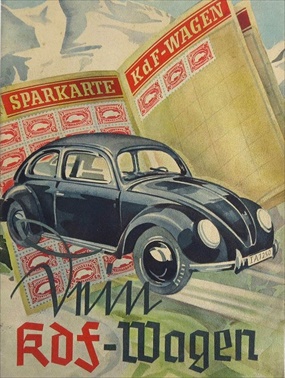
In 1934 Hitler approached Porsche as he and his design team finessed the Type 1 and successor models. The new German chancellor ordered the production of a basic vehicle whose engine would be powerful enough to traverse Germany’s future Autobahns, plus was capable of transporting 2 adults and 3 children at 100 km/h/62 mph. He envisioned a car every German family could afford. His version of the “People’s Car” would be available through a type of savings scheme known as a Sparkasse for a modest 990 Reichsmarks (equivalent to $396 in 1938)—this was about the price of a small German motorcycle! Because he could, Hitler did an end run around reluctant private carmakers by setting up a state-owned company to produce cars based on Porsche’s designs using the proceeds from people buying and then pasting 5 RM stamps into their Sparkarten (savings booklets) (see image below). Sadly for holders of completed saving stamp books, with a single exception, not one KdF-Wagen was delivered into their hands. The sole recipient was Hitler, who acquired a Type 1 convertible on his 55th birthday, April 20, 1944.
World War II changed KdF-Wagen’s civilian production to military production for the Wehrmacht. The Type 82 Kuebelwagen (“Bucket car”) utility vehicle (the pre-production model was tested during the 1939 invasion of Poland) and the amphibious Type 166 Schwimmwagen became VW’s most common wartime models. As was commonplace with much of wartime production in Nazi Germany, slave and civilian forced labor was essential to running the KdF-Wagen plant. In 1998 VW admitted that its predecessor company employed 15,000 slave laborers during the war. German historians estimate that a full 80 percent of Volkswagen’s wartime workforce was composed of slave laborers. Many former slaves reported that VW plant managers reached out to the local Arbeitsdorf concentration camp (a subcamp of Neuengamme concentration camp near the port of Hamburg), 3 other concentration camps (including Auschwitz), and 8 forced labor camps to fill its labor force.
Volkswagen: The War Years, 1939–1945
 |
 |
Left: On May 26, 1938, Hitler, Nazi dignitaries, and hundreds of guests gathered near Fallersleben in Northern Germany to lay the foundation stone for what we now call the Volkswagen Works. The Fuehrer delivered the keynote address, predicting that this People’s Car, initially known as the Kraft-durch-Freude-Wagen, or KdF-Wagen, would be “a symbol of the National Socialist people’s community.” (In the row of guests behind Hitler, holding a dark hat in his hands, is Ferdinand Porsche.) The plant eventually became a massive complex known as the “City of the KdF-Car” (“Stadt der KdF-Wagen”) and was projected to produce at least 1.5 million cars annually. In reality the plant had only just started small-scale production of what we call today the Volkswagen Beetle when it halted civilian production and converted to manufacturing military hardware at the start of World War II. Some Beetles continued to be produced but were reserved for military officials.
Right: It was far beyond the ability of the typical wage earner to purchase a car, even one as reasonably priced as the KdF-Wagen. (Average German income was around 32 Reichsmarks a week.) Dues-paying members of Germany’s only labor union, the DAF, could hardly be expected to fund setting up a car factory to meet the predicted order numbers. So Hitler and the Nazis offered the car to people under a savings scheme known as KdF-Wagen Sparkarte (“savings booklet”). The Sparkarte contained 4 cards, each with spaces for 50 stamps. One stamp represented the 5 Reichsmarks paid into the savings scheme. Citizens were encouraged to contribute this amount every week, although they could buy more stamps if they could afford it. Because the car had a price tag of 990 Reichsmarks, savers needed 198 stamps to be eligible to take possession of their car. At 5 Reichsmarks per week, it would have taken about 3 years and 9 months to fill all the cards. Still, around 336,000 individuals bought into the savings plan. The car-producing factory itself never became commercially viable, and only government intervention and the onset of a global war kept it afloat. As for citizens who had religiously filled their savings books with the requisite number of stamps, they never received their cars.
 |
 |
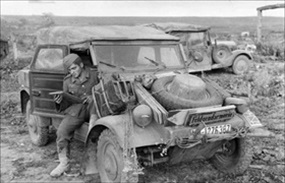
Left: A German Type 82 Kuebelwagen/Kübelwagen (literally, tub or bucket car) on the Eastern Front during Germany’s Operation Citadel, June 21, 1943. Full-scale production of the Type 82 Kuebelwagen started in February 1940 as soon as VW factories become operational. This was over a year before Willys and Ford began delivering Jeeps to the U.S. Army in the spring of 1941. Based on the platform of the civilian Volkswagen Beetle, the Kuebelwagen was surprisingly useful, reliable, and durable as a military vehicle. No major changes took place before Kuebelwagen production ended in 1945, and only small modifications were ever implemented. Prototype versions were assembled with 4‑wheel-drive (Type 86) and different engines, but none offered a significant increase in performance or capability over the existing Type 82. When production ceased at the end of the war, 50,435 Kuebelwagen vehicles had been built.
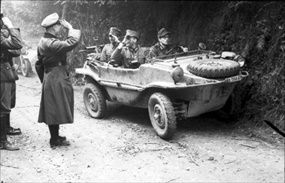
Right: German officers are seen saluting each other on a road somewhere in France in this photograph taken in 1944 by “Kriegsberichter Koll,” a member of the Propagandakompanie der Wehrmacht. The most numerous mass-produced amphibious car in history, the Schwimmwagen (literally, “swimming car”) was a 4‑wheel drive vehicle used extensively by German ground forces during World War II. It entered full-scale production as the Type 166 in 1941. When its retractable propeller was engaged the Schwimmwagen had a top speed of 10 km/h/6 mph in the water. Some 15,584 Schwimmwagen were built from 1941 through 1944: 14,276 at Fallersleben (Stadt des KdF-Wagens) and 1,308 at Porsche’s facilities in Stuttgart. The bodies (or rather hulls) were fabricated in Berlin.
The Rise and Fall of the Volkswagen Beetle

World War II was the single most devastating and horrific event in the history of the world, causing the death of some 70 million people, reshaping the political map of the twentieth century and ushering in a new era of world history. Every day The Daily Chronicles brings you a new story from the annals of World War II with a vision to preserve the memory of those who suffered in the greatest military conflict the world has ever seen.