

U.S. EXTENDS LEND-LEASE TO SOVIET UNION
Washington, D.C. • November 7, 1941
On March 11, 1941, U.S. President Franklin D. Roosevelt signed into law the Lend-Lease Act, which was a government-back program under which the still-neutral United States would begin supplying Great Britain and members of the British Commonwealth (Australia and New Zealand, for instance), Free French Forces led by Gen. Charles de Gaulle, the Nationalist Republic of China under Chiang Kai-shek, and later other Allied belligerent nations whose defense was deemed vital to the security of the U.S. Lent or leased but not sold, the military and economic aid consisted of food, clothing, oil, warships and warplanes, aviation fuel, armored fighting vehicles, ammunition, trucks, tires, machine tools, steam locomotives and rolling stock, etc. The hallmark legislation overturned three successive Neutrality Acts and the “cash and carry” program from the 1930s aimed at keeping the nation out of overseas entanglements.
On this date, November 7, 1941, the U.S. Congress formally consented to extend Lend-Lease privileges to the Soviet Union after Roosevelt had approved $1 billion in Lend-Lease aid to the Soviets on October 30. U.S. aid came at the request Soviet leader Joseph Stalin shortly after the German Wehrmacht (armed forces) had invaded the Soviet Union on June 22, 1941 (Operation Barbarossa)—this despite a nonaggression pact the two former antagonists had entered into in August 1939. Soviet manpower and equipment losses that first summer and autumn were staggering. Stalin and Red Army bosses realized their countrymen might have a fighting chance against their Axis enemies if the U.S. would send 6,000 aircraft and 20,000 anti-aircraft guns and if the British, at war with Germany and its Axis allies since September 1939, would send 3,000 fighters, 3,000 bombers, and war-related raw materials such as aluminum and rubber. The Soviet leader was fearful his country might be crushed by Axis armor within a few short months: more than 2,000 aircraft were lost on the first day of the German sneak attack, rising to 5,000 by July 5 and almost 18,000 by year’s end. Just as bad, 20,500 Soviet tanks, including new production, had been destroyed or abandoned as the end of year approached. Stalin urged Roosevelt and British Prime Minister Winston Churchill to dispatch ASAP 25 to 30 divisions for “military cooperation with Soviet troops on Soviet soil.”
British, Canadian, and U.S. aid (but not combat troops) began pouring into the Soviet Union almost immediately by air, sea, and land (see map below). The aid, most of which took the form of interest-free loans, was a key component in the Red Army’s victory over the Axis powers in World War II. The British, for instance, dispatched 700 aircraft, 500 tanks, 900 vehicles, and 76,000 tons of other supplies before the year was out. By the end of 1942 the U.S, playing catch-up, had sent 2,600 first-line planes, 3,200 tanks, and 81,000 other vehicles (e.g., trucks, half-tracks, and jeeps). The deliveries filled a critical gap while destroyed and displaced Soviet factories came back on line. At the Big Three Conference in Tehran (November 28 to December 1, 1943), Stalin admitted to Roosevelt and Churchill (he was talking about aircraft): “The United States is the land of machines. Without the use of those machines, without the aid of Lend-Lease, we would have lost the war.” Stalin’s admission was never heard by the average Soviet citizen.
By war’s end the U.S., Great Britain, and Canada had provided $11.3 billion (worth $163.4 billion today) of military and civilian Lend-Lease assistance to the Soviet Union. The Soviet Union and its successor polity Russia paid off their U.S. Lend-Lease obligations after initially rejecting a request for $1.3 billion to settle their debt. The U.S. eventually accepted $722 million, with the balance written off due to “destroyed, lost, or used” military (but not civilian) equipment.
U.S. Lend-Lease to the Soviet Union in World War II
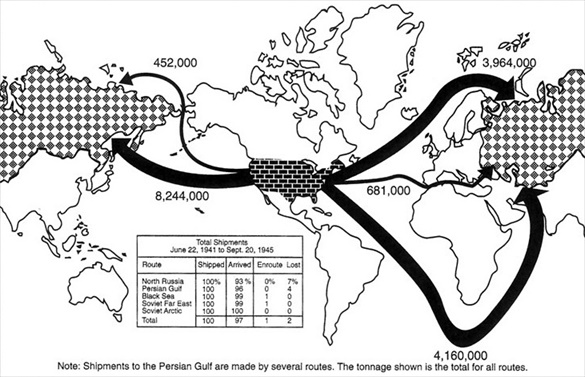 |
Above: Map shows Lend-Lease shipments to the Soviet Union using various sea routes between mid-1941, 5 months before the U.S. was drawn into World War II, and September 1945. (Not depicted are shipments by air.) Between October 1, 1941, and May 31, 1945, some 2,660 ships sailed from U.S. ports with 16,529,791 tons of Soviet-bound supplies, among which were 14,795 aircraft and 375,883 trucks The first U.S. Lend-Lease shipments were conveyed in Arctic convoys that followed the northern route around Scandinavia. They delivered nearly 4 million tons chiefly to two North Russian ports and were the most dangerous deliveries of the conflict owing to German U‑boat, commerce raider, and Luftwaffe attacks from occupied Norway. (Eighty-five merchantmen in Arctic convoys were intercepted and sunk by Germans, including one with 4.5 tons of gold intended for the U.S. Treasury; check out Battle of the Atlantic.) The Iranian route around South Africa first operated in September 1941; rail routes in the Persian Gulf connected with the Soviet rail network and delivered just under 4.2 million tons. A minor sea route delivered supplies through the Mediterranean and Black Seas. The trans-Pacific route to the Soviet Far East, using Soviet-flagged ships, opened a month after Lend-Lease was extended to the Soviet Union. It accounted for half the total Lend-Lease goods the Soviets received but, by agreement with Japan, the goods were nonmilitary. A minor route delivered supplies to the Soviet Arctic via the Bering Sea.
 |
 |
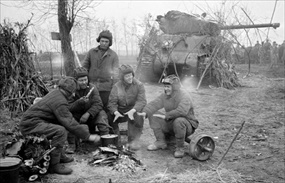
Left: 1st Baltic Front tankers rest near their M4 Sherman medium tank, one of 4,000 M4 Shermans out of the 49,234 built that the Soviets received under U.S. Lend-Lease. (As much as 40 percent of the Red Army’s heavier tanks were Lend-Lease.) A major formation of the Red Army, the 1st Baltic Front took part in several important military operations, most notably Operation Bagration in the summer of 1944. The 1st Baltic Front also assisted in lifting the 872-day Siege of Leningrad on January 27, 1944, as well as capturing Fortress Koenigsberg in East Prussia in April 1945.
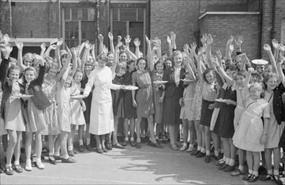
Right: A group of smiling schoolgirls wave for the camera as they receive plates of imported bacon and eggs as part of the U.S. Lend-Lease program. The school principal (center) passes out plates of food using two hands. The photograph was snapped on the school playground and was probably taken in late August or early September 1941 as some of the first Lend-Lease food shipments reached Great Britain. By the end of the war, the U.S. had extended over $50 billion (equivalent to nearly $876 billion in 2024) in Lend-Lease aid to nearly 40 nations.
 |
 |
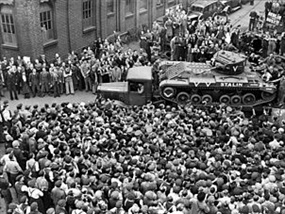
Left: A Valentine tank destined for the Soviet Union leaves a British factory. Crowds of people and an honor guard of tanks greet Soviet ambassador Ivan Mikhailovich Maisky, his wife, and members of the Soviet military mission when they arrived at a tank factory, where the week’s tank production was Soviet-bound. The tank on the truck bed is named “Stalin” and has just been christened by Madame Maisky.
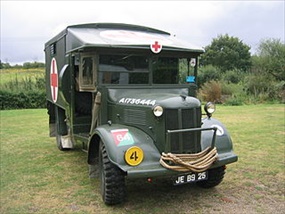
Right: Not all Lend-Lease aid went from the U.S. (the world’s “arsenal of democracy”) to its wartime partners. Reversing direction, U.S. Lend-Lease allies provided nearly $8 billion (about $138 billion in 2024) worth of goods and services, 90 percent of this sum coming from Britain and its Commonwealth. Reciprocal contributions (reverse lend-lease) included the Austin K2/Y military ambulance shown here used by the U.S. Army; British aviation spark plugs used in B‑17 Flying Fortresses; Canadian-built Fairmile launches used by the U.S. Navy as submarine chasers; de Havilland Mosquito photo-reconnaissance aircraft; and contributions to the Manhattan Project that produced the world’s first nuclear weapons. Australia and New Zealand supplied the bulk of foodstuffs to U.S. forces in the South Pacific. Though tiny in comparison, the Soviet Union supplied the U.S. with badly needed rare minerals such as chrome ore (300,000 tons), manganese ore (32,000 tons), and large supplies of platinum and gold, or about $2 million in then reverse Lend-Lease.
Contemporary British Newsreel Documenting U.S. Lend-Lease Supplies Arriving in Britain, 1941

World War II was the single most devastating and horrific event in the history of the world, causing the death of some 70 million people, reshaping the political map of the twentieth century and ushering in a new era of world history. Every day The Daily Chronicles brings you a new story from the annals of World War II with a vision to preserve the memory of those who suffered in the greatest military conflict the world has ever seen.