

HEYDRICH TASKED WITH SOLVING “JEWISH QUESTION”
Berlin, Germany • July 31, 1941
On this date in 1941 Reichsmarshall Hermann Goering formally empowered SS‑Gruppenfuehrer (German, Group Leader) Reinhard Heydrich to undertake “preparations in organizational, technical and material respects for the complete solution to the Jewish question in the German area of influence in Europe.” At this time neither Goering, nor his boss Adolf Hitler (who communicated his views on the fate of Jews via Goering), nor Heydrich, sinister head of the Reichssicherheitshauptamt (Reich Security Main Office, RSHA) had given any thought to, much less developed any comprehensive plan for, the racial “purification” of Europe by systematically murdering all Jews within or on the periphery of the German sphere of influence. Senior Nazi officials directed their thoughts to “evacuating” Jews to areas outside the Reich (in 1940 to the inhospitable island of Madagascar in the Western Indian Ocean or to unoccupied Vichy France), though the anti-Semitic Heydrich, since at least the 1939 invasion of Poland, was keen on seeing as many Jewish expellees “eradicated” through hunger, thirst, exhaustion, or disease en route to or at their destination.
Heydrich transitioned over a 2-year period from, first, stuffing European Jews into urban ghettos to facilitate their future deportation to a yet unknown destination (a short-term solution); to heightened brutalization, persecution, arrest, and small-scale, step-by-step expulsion of Jews to the most-distant reaches of the newly expanded Reich (a territorial solution); to, finally, plotting racial genocide on a gargantuan scale, an obsession intensified and affirmed by the Third Reich’s power elites in the winter of 1941–1942 after Germany and the United States declared war on each other. The Wannsee Conference of senior government and Schutzstaffel (SS) officials in a suburb of Berlin on January 20, 1942, called by Heydrich, ensured that he, as the designated leader, loyally supported by civil and Nazi Party authorities, were of one mind in energetically implementing the final solution of the Jewish question (German, Endloesung der Judenfrage), whereby most Jews in Nazi-controlled Europe and in its allied Southeast European puppet states would be rounded up en masse, deported to occupied Poland, and murdered in specially built SS extermination camps.
The terrible final reckoning—the genocide of two-thirds of Europe’s Jewish population—was first tried out on Soviet POWs using the powerful chemical fumigant Zyklon B in September 1941 at Auschwitz I, a concentration camp in German-annexed Poland. Beginning in November that year, a key element in the Nazis’ “Final Solution,” Operation Reinhard (German, Aktion Reinhard in honor of Heydrich), saw the construction of the first purpose-built gas chamber for murdering Jews—this at Bełżec in Southeastern Poland. In a few short months Sobibór and Treblinka were added to the secret list of Reinhard killing centers (see map below). POW and forced labor camps were established at Majdanek/Lubin and Auschwitz II-Birkenau, also in occupied Poland, and they too assisted in advancing Operation Reinhard’s mission of murdering Jews on an industrial scale.
Operation Reinhard formally ended in early November 1943, almost a year and a half after Heydrich himself was mortally struck down by 2 Czechoslovak patriots in Operation Antropoid. During Operation Reinhard, close to 2.5 million Jews were annihilated, but the mass murder of Jews and other “undesirables” (e.g., Soviet civilians and POWs, Serbs, Roma (Gypsies), gays, political opponents, and “invalids,” or the disabled) continued almost to the end of the European War in May 1945. In all, the Holocaust (in Hebrew, Shoah, or catastrophe) claimed the lives of roughly 6 out of 11 million European Jews.
Reinhard Heydrich (1904–1942) is widely recognized as one of the great villains of Nazi Germany, a nation that had a surplus of loathsome individuals. Robert Gerwarth’s biography of Reinhard Heydrich, titled Hitler’s Hangman: The Life of Heydrich—“hangman” being a moniker Heydrich would have worn with pride—examines Heydrich’s years as a ruthless, amoral, and cynically efficient acolyte in Heinrich Himmler’s SS, where he directed the Reich Security Main Office, which oversaw the Gestapo (Secret State Police) and the Sipo (Security Police); his role as a leading planner of the “Final Solution” and the Holocaust of European Jewry; and his 8 months as Acting Reich Protector of Bohemia and Moravia, a semi-autonomous but Nazi-administered territory in what is today’s Czech Republic (Czechia). Up till his fatal encounter with 2 Czechoslovak nationalists, Heydrich was widely viewed as the most dangerous man in Nazi Germany. Gerwarth explains why in this authoritative biography of evil incarnate.—Norm Haskett
Racial Purification and Reordering Through Genocide: The Jewish Holocaust in Central and Eastern Europe
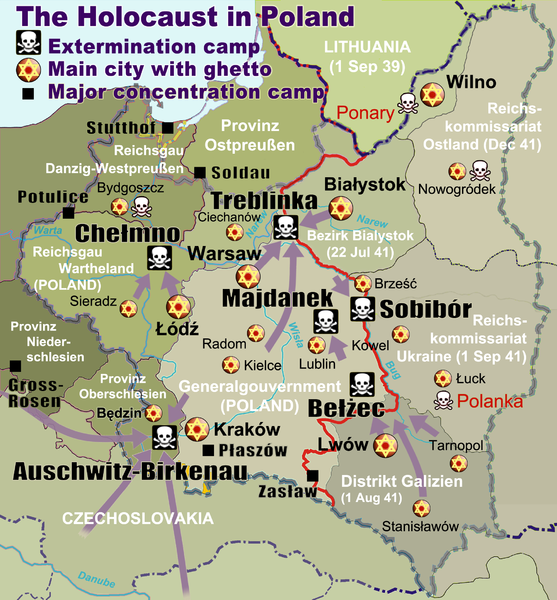
Above: The estimated total number of people murdered in extermination camps in German-occupied Poland is over 3 million. This number does not include the hundreds of thousands of mass shootings of Jews by Heydrich’s Einsatzgruppen (special task forces) and special SS “anti-partisan” units that flooded into Poland after September 1, 1939, and later Ukraine and Belorussia (Belarus) during Hitler’s bloody campaign against the Soviet Union. Jews made up the largest percentage of pan-European victims murdered in camps: Auschwitz-Birkenau (Poland), 1,100,000, of which ~87 percent were Jews; Treblinka (Poland), 700,000–800,000, almost all were Jews; Bełżec (Poland), 430,000–600,000, almost all were Jews; Sobibór (Poland), 170,000–250,000, almost all were Jews; Chełmno (Poland), 152,000–200,000, most were Jews; Majdanek (Poland), 78,000, 75 percent were Jews; Maly Trostenets (Belarus), 65,000–106,000 Jews; and Jasenovac (Croatia), 77,000–100,000, 12–15 percent were Jews. The latter 2 killing sites are not shown on this map. Also not shown on the map are at least 360,000 Soviet Jews in the Ukraine and Belarus shot by Heydrich’s Einsatzgruppen and special SS “anti-partisan” units in the spring and summer of 1942.
 |
 |
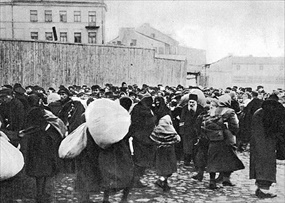
Left: Deportation of Jews to Bełżec from Zamość in Southeastern Poland, April 1942. The first of the Nazi killing sites in the former Polish territories, Bełżec operated from mid-March 1942 to the end of June 1943, when the last convoy of Jews arrived. Between 430,000 and 600,000 Jews are believed to have been systematically murdered by the SS at Bełżec. This makes Bełżec the third-deadliest extermination camp, exceeded only by Auschwitz and Treblinka. Only 7 Jews performing slave labor with the camp’s Sonderkommando (Jewish forced laborers) survived World War II. The lack of viable witnesses who could testify about the camp’s operation is the primary reason why Bełżec is so little known despite the enormous number of victims.
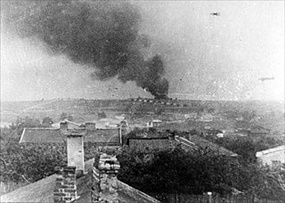
Right: Smoke allegedly rising from a burning pyre of corpses at Majdanek in October 1943. The forced labor-cum-extermination camp, initially established in October 1941 to hold Soviet soldiers captured in Operation Barbarossa, had 7 gas chambers. Some 18,400 Majdanek-held Jews were killed in a single day in November 1943. Executions by hanging and firing squad (780 shot in January 1944 alone) occurred regularly. Of the more than 2.5 million Jews killed in the course of Operation Reinhard, some 60,000 Jews (56,000 known by name) were most certainly exterminated at Majdanek. Majdanek was the first major concentration camp liberated by Allied forces, this by Red Army troops on July 24, 1944, and the horrors found there were widely publicized. The American newsweekly, Time Magazine, published an article on Majdanek’s horrors on August 21, 1944.
Reinhard Heydrich (1904–1942) and the “Final Solution”

World War II was the single most devastating and horrific event in the history of the world, causing the death of some 70 million people, reshaping the political map of the twentieth century and ushering in a new era of world history. Every day The Daily Chronicles brings you a new story from the annals of World War II with a vision to preserve the memory of those who suffered in the greatest military conflict the world has ever seen.