

SOVIETS LIBERATE AUSCHWITZ-BIRKENAU DEATH CAMP
Auschwitz-Birkenau, Poland • January 27, 1945
In the months following the Red Army’s entry into the abandoned Nazi death camp at Majdanek on the outskirts of Lublin, Poland, where more than 79,000 people had been killed, the growing list of liberated camps (the Nazis had over 40 death camps) characterized by mounds of corpses and emaciated survivors revealed the essence of Nazi evil and horror.
At 3 p.m. on this date, January 27, 1945, 81 years ago, Soviet troops reached Auschwitz-Birkenau (Polish, Oświęcim), 40 miles/64 km west of Cracow (Kraków) in Southern Poland, the largest and arguably most diabolical and infamous of the Nazi concentration and death camps. There they found 648 corpses and 7,000 survivors—1,200 at the Auschwitz main camp (there were 45 subcamps) and 5,800 at Birkenau, the larger of the 2 camps less than 2 miles/3.2 km away. (Most of the people transported to Auschwitz actually never entered the main camp, but just crossed it on their way to the Birkenau gas chambers.) In the rush to greet their rescuers, some inmates died on the 13‑foot/4‑meter‑high electric fences that surrounded the camps. More survivors would have been found (estimated at roughly 60,000) had Auschwitz-Birkenau not been hastily evacuated by SS camp guards, who forced-marched inmates to other camps outside the Red Army’s reach such as Bergen-Belsen (33 miles/53 km northeast of Hannover), Dachau (10 miles/16 km northwest of Munich), and Sachsenhausen (21 miles/34 km north of Berlin). Approximately 15,000 prisoners died on these death marches before the Soviets arrived at Auschwitz-Birkenau.
Established under Reichsfuehrer-SS Heinrich Himmler in 1940 at an abandoned Polish military base and expanded by camp commandant Rudolf Hoess (Höss, pronounced “hearse”), Auschwitz originally housed Soviet POWs, but it also processed homosexuals, Roma (Gypsies), Jehovah’s Witnesses, people with disabilities, and others deemed undesirable, especially Jews, as well as those rounded up under Nacht und Nebel, the Nazis’ “disappearance” campaign. Of the 3 million Polish Jews killed during the Third Reich, over 1 million were killed at Auschwitz-Birkenau, a figure representing 75 percent of the nearly 1.3 million people imprisoned at Auschwitz between 1940 and 1945. Toward the end of the war, as many as 10,000 people were gassed daily at the Birkenau complex.
A July 2, 1947, act of the Polish parliament established the Auschwitz-Birkenau State Museum on the grounds of the 2 extant parts of the camp, Auschwitz I (the Stammlager, or main camp) and Auschwitz II-Birkenau (the Vernichtungslager, or extermination camp). Today’s date, January 27, the 81st anniversary of Auschwitz’s liberation, is commemorated around the world as International Holocaust Remembrance Day.
Concentration/Death Camp Auschwitz-Birkenau, May 1940 to January 1945
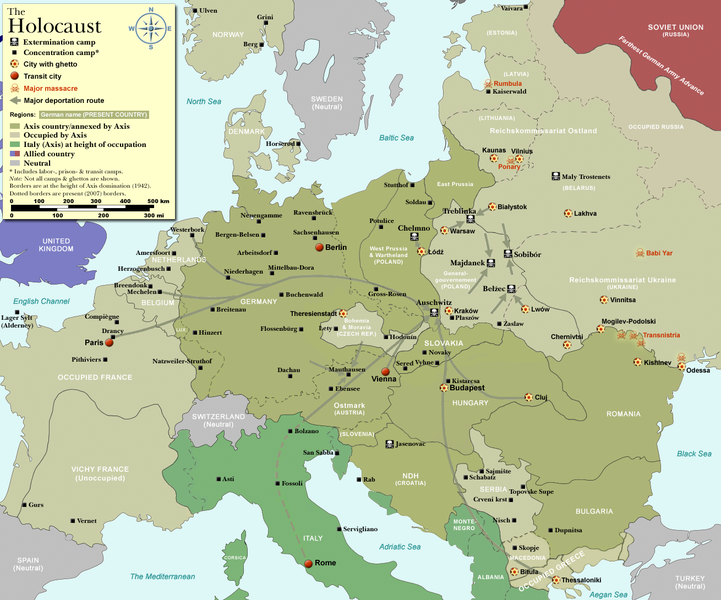 |
Above: Routes to the major death (extermination) camps (signified by hard-to-see skull and crossbones in black box) in Germany, Poland, Belarus, and Croatia. The estimated total number of people killed in the camps is over 3 million: Auschwitz-Birkenau (Poland), estimated 1,100,000; Bełżec (Poland), 430,000–500,000; Chełmno/Kulmhof (Poland), 152,000–340,000; Majdanek (Poland), estimated 78,000; Sobibór (Poland), 250,000–350,000; Treblinka (Poland), 700,000–900,000; Maly Trostenets (Belarus), 60,000–65,000; and Jasenovac (Croatia), 85,000–600,000. Of the camps listed here, Bełżec, Sobibór, and Treblinka were the deadliest, even more so than Auschwitz-Birkenau, because the 3 were true extermination camps. They were set up under Operation Reinhard (October 1941 to November 1943), the most lethal phase of the so-called Final Solution to the Jewish Question (German, die Endloesung der Judenfrage), which was set in motion at the January 1942 Wannsee Conference outside Berlin that resulted in the murder of 90 percent of Poland’s Jews and two‑thirds of Europe’s Jewish population during the Holocaust, or Shoah. (Twenty-five percent of the Holocaust’s victims were killed in just 3 months during Operation Reinhard.) Unlike Auschwitz-Birkienau and Majdanek, which operated as forced-labor camps initially before they became death camps fitted with crematoria, Bełżec, Sobibór, and Treblinka kept no prisoners except as a means of furthering the camps’ sole purpose of industrial-scale murder. Most camp prisoners were killed immediately on arrival.
 |
 |
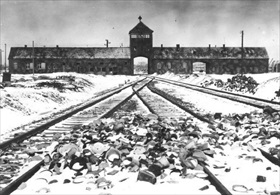
Left: Photo of Birkenau (the extermination camp at Auschwitz) following the camp’s liberation on January 27, 1945. In the foreground is the unloading ramp (the so-called Judenrampe) and in the distance Birkenau’s main gate called the “Gate of Death.” Auschwitz-Birkenau was the site where an estimated 1.1 million people, around 90 percent of them Jews, were killed in Birkenau’s gas chambers or by clubs and hatchets, shootings, hangings (usually during roll-call), disease (both natural [e.g., typhus] and medically inflicted), physical exhaustion, malnutrition, and starvation.
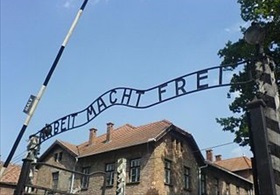
Right: Beginning on January 27, 1945, almost 9,000 prisoners in Auschwitz I (main camp), Auschwitz II-Birkenau (extermination camp), and Monowitz-Buna (Monowice, or Auschwitz III), whom the Nazis judged unfit to join the SS forced evacuation march, were liberated by Soviet troops, a day commemorated around the world as International Holocaust Remembrance Day. Over 230 Soviet soldiers died while liberating the camps, satellite camps, and the nearby town of Oświęcim. In 1947 Poland founded a museum on the site of Auschwitz I and II. Millions of visitors (1.83 million in 2024, down from 2.3 million in 2019) have passed through the iron entrance gate to Auschwitz crowned with the notoriously cynical inscription, ARBEIT MACHT FREI (“Work Sets You Free”). The arched inscription—designed and made by camp inmates—became the central symbol for the prisoners’ ordeal.
 |
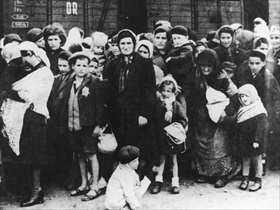 |
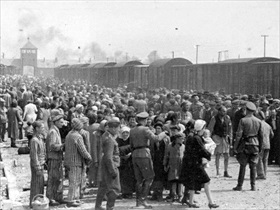
Left: Hungarian Jews on the Judenrampe after disembarking from windowless transport trains at Auschwitz. Tens of thousands of Hungarian Jews arrived every day. In the space of just 2 months, between May and July 1944, Hungary transported 420,000 Jews to Auschwitz, three‑quarters of them killed on arrival. Being directed rechts! (to the right) by camp authorities meant slave labor. Sent links! (to the left) meant the gas chambers at Birkenau.
Right: Hungarian Jewish mothers, children, elderly, and infirm sent links (left) after “selection” at Auschwitz, May 1944. Very soon they would be stripped of their clothing, herded into large shower rooms ostensibly for delousing, and killed using powerful Zyklon‑B gas pellets in the sealed chambers, thereby becoming part of the nearly 1 million Jews, out of at least 1.1 million victims, the Nazis systematically murdered at Auschwitz.
 |
 |
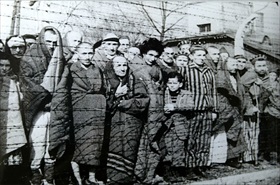
Left: Survivors at the camp liberated by the Red Army in January 1945. Army medics and orderlies gave the first organized help to survivors. Two Soviet field hospitals soon arrived and began caring for more than 4,500 ex-prisoners from more than 20 countries, most of them Jews. Numerous Polish volunteers from Oświęcim and the vicinity, as well as other parts of the country, also arrived to help. Most of the volunteers belonged to the Polish Red Cross. Liberated prisoners who were in relatively good physical condition left Auschwitz immediately. Most of the patients in the hospital did the same within 3 to 4 months.
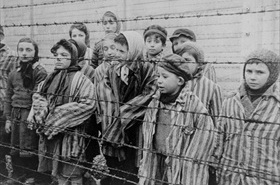
Right: Wearing adult-size prisoner jackets, child survivors of Auschwitz stand behind a barbed wire fence on the day of their liberation by the Red Army. The majority of the liberated child prisoners left Auschwitz in separate groups in February and March 1945, with most of them going to charitable institutions or children’s homes. Only a fortunate few were ever reunited with their parents.
Documentary: Concentration/Death Camp Auschwitz-Birkenau, 1940–1945. WARNING: Content will disturb some viewers

World War II was the single most devastating and horrific event in the history of the world, causing the death of some 70 million people, reshaping the political map of the twentieth century and ushering in a new era of world history. Every day The Daily Chronicles brings you a new story from the annals of World War II with a vision to preserve the memory of those who suffered in the greatest military conflict the world has ever seen.