

NAZI FLAG TRASHED, GERMAN CONSUL PROTESTS
New York City, New York · July 26, 1935
On this date in 1935 in New York Harbor, a group of anti-Nazi activists boarded the German passenger liner Bremen, tore from the ship’s jackstay the red, white, and black Nazi party flag, its swastika emblazoned in the center, and pitched it into the Hudson River. When the German consul in New York vigorously protested the flag’s desecration, U.S. officials responded that the German national flag had not been harmed, but only a political party symbol. On September 15, 1935, during a session of the Reichstag held in the German city of Nuremberg, where Nazi big-wigs and party members had opened their Party rally three days before, lawmakers remembered the New York outrage and declared the Nazi party flag to be the national flag of Germany.
Of more significance was the Reichstag’s passage of the Nuremberg Laws during the Party rally. One law, “The Law for the Protection of German Blood and Honor,” barred marriages and extramarital sex between “Germans” and “Jews” (Juden), the latter name now officially used in place of “non-Aryans,” and outlawed the employment in Jewish households of “German” females under the age of forty-five. Persons convicted of violating the law protecting German blood and honor faced hard labor, imprisonment with hard labor, and/or fines. (A secret decree in June 1937 stipulated that those guilty of “miscegenation” were to be sent to concentration camps following the completion of their sentence.) Another Nuremberg law, “The Reich Citizenship Law,” classified “Aryans” as Reichsbuerger (“Reich citizens”) and those not of “German or related blood” as “state subjects” (Staatsangehoerige) who henceforth lacked German citizenship rights.
The race laws were a legal embodiment of an already existing (since 1933) nationwide boycott of Jewish businesses and were tweaked numerous times from 1935 onwards. For instance, in July 1935 Jews were “released” from the armed services and Jewish civil servants who had been protected by their status as World War I veterans were dismissed from public service. In 1938 a total Berufsverbot (“professional disqualification”) was extended to all academically trained Jewish professionals, and Jews had their state pensions reduced. The race laws progressively lessened the status and human dignity of members of the Jewish community in Germany and, after the 1938 Anschluss, in Austria as well.
[fblike]
[amazon_carousel widget_type=”ASINList” width=”600″ height=”200″ title=”Recommended Reading” market_place=”US” shuffle_products=”False” show_border=”False” asin=”0300188544,0195130928,055334532X,1425914896,0253349451,0674027388,0252061470,025207453X,1416594272,0061350273″ /]
Milestones on the Road to the Holocaust Began with Legally Marginalizing German Jews
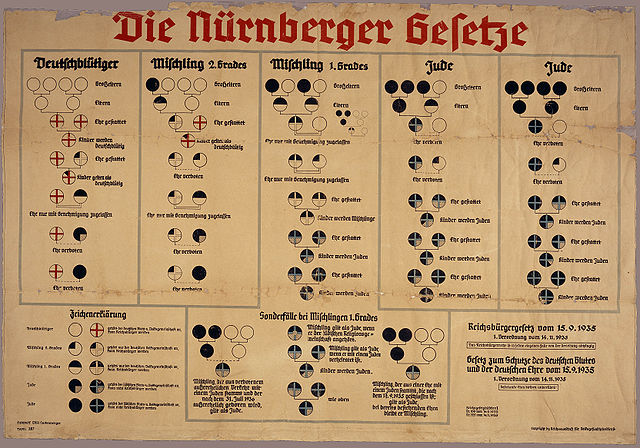 |
Above: The Nuremberg Laws established a pseudoscientific basis for racial identification. As shown in this chart from 1935, only people with four German grandparents (four white circles in top row left) were of “German blood” (Deutschbluetiger). A Jew (Jude) was someone who descended from three or four Jewish grandparents (black circles in top row right). In the middle stood people of “mixed blood” (Mischlinge) of the “first or second degree.” A Jewish grandparent was defined as a person who is or was a member of a Jewish religious community. The chart went on to list allowed marriages (“Ehe gestattet”) and forbidden marriages (“Ehe verboten”).
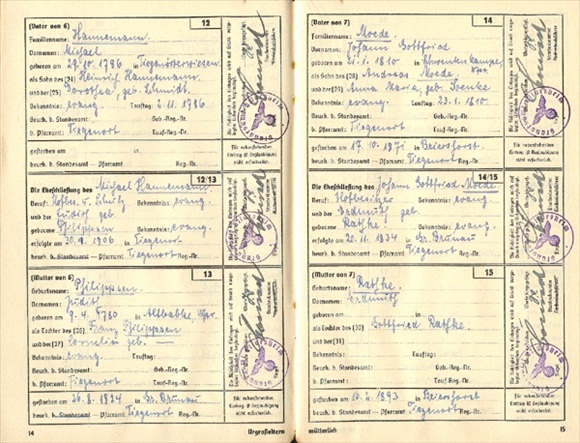 |
Above: The pages in the Ahnenpass (Ancestor Passport) documented the non-Jewish lineage of citizens of Nazi Germany and Austria. A proven Aryan lineage was required for working in the professions, attending high school or the university, owning real estate, and even getting married.
 |
 |
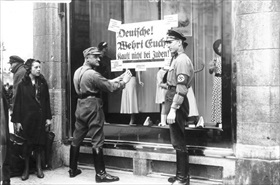
Left: In a state-managed campaign, Nazi Stormtroopers (SA “brownshirt” thugs who numbered three million in 1934) affix a poster to the window of a Berlin store with the words “Germans! Defend yourselves! Do not buy from Jews!” (“Deutsche! Wehrt Euch! Kauft nicht bei Juden!”), April 1, 1933. Other signs included “Whoever Buys from Jews Is Stealing the Nation’s Assets” (“Wer beim Juden kauft stiehlt Volksvermoegen”), “The Jews Are Our Misfortune!” (“Die Juden sind unser Unglueck!”), and “Go to Palestine!” (“Geh nach Palaestina!”). German shopkeepers sometimes placed signs on their front doors, “Jews Not Welcome” (“Juden nicht erwuenscht”). Park benches bore labels “For Aryans Only” (“Nur fuer Arier”) and bathing beaches were touted as Judenfrei.
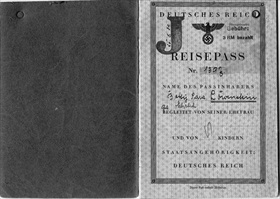
Right: In 1938 a Jew whose first name was not obviously “German” was required to change his or her middle name to “Israel” (male) or “Sara” (female) for use in all official communication and in legal and business documents. German passport holder Betty “Sara” Loewenstein, whose passport sprouted a large red “J,” was allowed to leave Germany but not return.
Photomontage of 1935 Nuremberg Nazi Party Rally and Its Outcome: The Nuremberg Race Laws (May want to mute the music)

World War II was the single most devastating and horrific event in the history of the world, causing the death of some 70 million people, reshaping the political map of the twentieth century and ushering in a new era of world history. Every day The Daily Chronicles brings you a new story from the annals of World War II with a vision to preserve the memory of those who suffered in the greatest military conflict the world has ever seen.