

HIMMLER PROPOSES GERMAN SURRENDER TERMS
Luebeck, Northern Germany • April 24, 1945
Reichsfuehrer-SS, Reich Minister of the Interior, Gestapo chief, and Adolf Hitler-devotee Heinrich Himmler began making clumsy attempts to secure a separate peace treaty with the Western Allies as German defenders of the Reich capital—ground zero of Nazi resistance—failed to push the Red Army back across the Spree River, the last physical barrier to the Soviet conquest of Berlin. Himmler was in Berlin on April 20, 1945, to congratulate Hitler on the occasion of the Fuehrer’s 56th birthday—a somber one spent in the clammy gray bowels of the Reich Chancellery bunker—then scampered away to Northern Germany.
Meeting in the Baltic port city of Luebeck on the night of April 23/24, 1945, with Count Folke Bernadotte, vice-president of the Swedish Red Cross, and without his master’s knowledge, Himmler offered German capitulation on the Western Front but not on the Soviet Front. (Himmler misrepresented himself to Bernadotte as the provisional leader of Germany, believing Hitler would shortly commit suicide or had already done so.) Bernadotte forwarded Himmler’s terms to the Western Allies through the Swedish Foreign Ministry. The Allies replied tersely that German capitulation could only be accepted if it embraced all fronts, and that the Allies would continue pressing their attacks until they had achieved complete victory. For Hitler, the backdoor scheming of “der treue Heinrich” (“the faithful Heinrich”—the epithet refers back to the well-known Brothers Grimm fairy tale, The Frog Prince, or Iron Henry) was the last straw, especially when it was confirmed by the British Reuters news agency and broadcast for all the world to know on April 28.
To the few Nazi stalwarts still with him in his Berlin bunker Hitler ranted that Himmler’s act of treachery was the worst he had ever known. He ordered Himmler’s immediate arrest, expelled the former Reichsfuehrer-SS from the Nazi Party and from all offices of the state, and ordered the execution of Hermann Fegelein, Himmler’s SS representative at Fuehrer HQ Berlin. Late on the night of April 28 Hitler married Fegelein’s sister-in-law, Eva Braun, with whom he had a 14‑year intimate relationship. Then he dictated a political statement and last will and testament, named as his political successor Grand Admiral Karl Doenitz (in Flensburg, Northern Germany, near the Danish border), and took his life and that of Braun on April 30.
Dismissed by Doenitz on May 6 from all his offices—the admiral wanted nothing to do with the notorious and conniving SS chief—Himmler now went into hiding, heading south in the direction of Bavaria with some of his top SS associates. He shaved off his moustache and adopted the alias ex-Sgt. Heinrich Hitzinger. He and his small band joined a larger wandering party of disarmed soldiers and civilians. At a British Army checkpoint on a bridge he and his party needed to cross Himmler held back. The checkpoint was also an intelligence screening point set up by British Army Field Security, which was searching for people named on the automatic arrest list of leading Nazis and war criminals. A roving army patrol soon caught up with Himmler disguised in civilian clothes and wearing a black eye patch and a blue raincoat. Reunited with the rest of his traveling party at a civil internment camp, Himmler calmly revealed his true identity during interrogation. A glass vial of poison had been found in his possession and removed but Himmler had secreted another one in his mouth and crushed it between his teeth during a doctor’s examination on May 23, 1945. Frantic British efforts to save him were for naught. His body was autopsied and photographed, wrapped in blankets and camouflage nets, then trussed up with telephone wires. In a lonely patch some distance away Himmler was casually tossed into an unmarked grave like countless millions of his victims.
Heinrich Himmler was as evil a man as ever lived, as I learned in 2 fine biographies of the second-most powerful man in Nazi Germany, one authored by Roger Manvell and Heinrich Fraenkel (Heinrich Himmler: The Sinister Life of the Head of the SS and Gestapo), the other by Peter Longerich (Heinrich Himmler: A Life). But then I read Robert Gerwarth’s biography of Reinhard Heydrich, titled Hitler’s Hangman: The Life of Heydrich—“hangman” being 1 of 3 nicknames Heydrich wore with pride. Up till his fatal encounter with two Czech nationalists, Heydrich was widely viewed as the most dangerous man in Nazi Germany. Gerwarth explains why in this authoritative biography of evil incarnate.—Norm Haskett
Reichsfuehrer-SS Heinrich Himmler: The Second Power in Adolf Hitler’s Germany
 |
 |
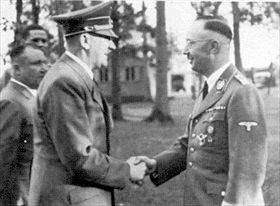
Left: Head of the SS (short for Schutzstaffel, the Nazi party protection squads) from 1929 to 1945 and chief of the Gestapo (secret state police) from 1934 to 1945, Himmler was second to Hitler as the most powerful man in Nazi Germany. From 1943 to 1945 Himmler held another post, Minister of the Interior; in this position, he is one of the persons most directly responsible for the Holocaust.
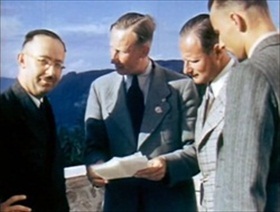
Right: Himmler (left) with Reinhard Heydrich (holding sheets of paper) at Hitler’s Bavarian retreat, the Berghof, situated atop the 6,700‑foot/2,042‑meter mountain called Obersalzberg, 1939. Heydrich, ruthless head of the Reich Security Head Office (Reichssicherheitshauptamt, or RSHA), worked under Himmler. In July 1941 Reichsmarschall Hermann Goering ordered the conscienceless and more-than-willing Heydrich to prepare the “Final Solution”—the extermination of all Jews in German-occupied Europe. Heydrich was mortally wounded on May 27, 1942, in Prague by 2 Czech resistance operatives. The “Butcher of Prague,” one of his less affectionate nicknames, developed a systemic infection and died 9 days later, his painful death attributed to several contradictory causes.
 |
 |
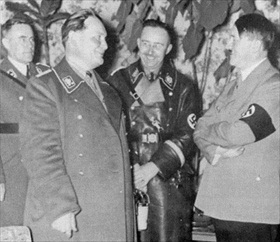
Left: Speaking to Reichstag members on the day of the German invasion of Poland, September 1, 1939, Hitler tapped Goering, seen here with Himmler, to be his successor “if anything should befall me.” Hitler formalized his succession in a secret decree on June 29, 1941. From 1942 onward Goering largely withdrew from the military and political scene when the Luftwaffe, which he headed, stumbled on both the Western and Eastern fronts.
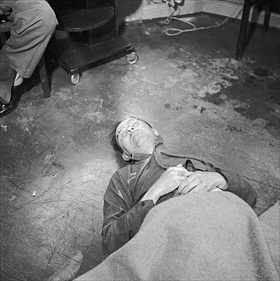
Right: Himmler’s body on the floor of British 2nd Army HQ in Lueneburg after biting down on a cyanide capsule during a late morning interrogation on May 23, 1945. He died within 15 minutes despite efforts to revive him. Three days later he was buried in an unmarked grave near Lueneburg, 28 miles/45 kilometers southeast of Hamburg, in the German state of Lower Saxony.
Biographic’s Heinrich Himmler: The Dark Side of Human Nature

World War II was the single most devastating and horrific event in the history of the world, causing the death of some 70 million people, reshaping the political map of the twentieth century and ushering in a new era of world history. Every day The Daily Chronicles brings you a new story from the annals of World War II with a vision to preserve the memory of those who suffered in the greatest military conflict the world has ever seen.