

CHINESE “QUISLING” OUSTS CHIANG REGIME
Nanjing (Nanking), China · March 30, 1940
By 1940 Japan had close to a decade’s worth of experience in administering conquered Chinese territory, having installed a puppet government in 1932 in Manchuria, which the Japanese called Manchukuo. On this date in 1940 in Nanjing (Nanking), China, the Japanese installed Wang Jingwei (Ching-wei) as head of state of the Japanese collaborationist government of the Republic of China.
Nanjing had formerly been the capital of Chiang Kai-shek’s Nationalist government, which had moved the nation’s capital from Beijing (Peking). But following the Battle of Shanghai (August 13 to November 28, 1937), during which the Nationalist (Kuomintang) Army unsuccessfully tried pushing Japanese soldiers out of China’s second largest city, Japan’s military leaders fixed their sights on revenge for the costly four-month-long battle in which roughly 320,000 combatants on both sides died. Plunder, destruction, sadism, rape, and murder were the names of the undisciplined Japanese foot soldiers who advanced on Nanjing. For six weeks following the city’s capitulation on December 13, 1937, thousands of civilians and disarmed soldiers were murdered and 20,000–80,000 men, women, and children were raped in what became known as The Rape of Nanking (see video).
Wang headed a pro-Japanese regime that was strongly anti-Communist. In November 1941 he joined with the leaders of Japan, Italy, and Nazi Germany in the Anti-Comintern Pact, a thirteen-nation alliance against the Soviet Union. Wang’s regime also stood in direct opposition to the American-supported government of Chiang Kai-shek, whose agents tried to assassinate Wang two years earlier. (Chiang moved his government from Nanjing to Wuhan and later to Chongqing, or Chungking.) Wang’s government only held authority over Chinese territories under Japanese military occupation. It was deeply unpopular with the Chinese populace, and it was constantly undermined by resistance and sabotage from within and from Nationalist and Communist Chinese from without.
The 61-year-old Wang died in Japan, less than a year before that country’s surrender to the Allies in September 1945, thus avoiding a trial for treason and war crimes. Many of Wang’s followers who lived to see the end of the war were executed by his Nationalist and Communist opponents.
China and Wang Jingwei, Head of the Japanese Puppet Regime at Nanjing (Nanking)
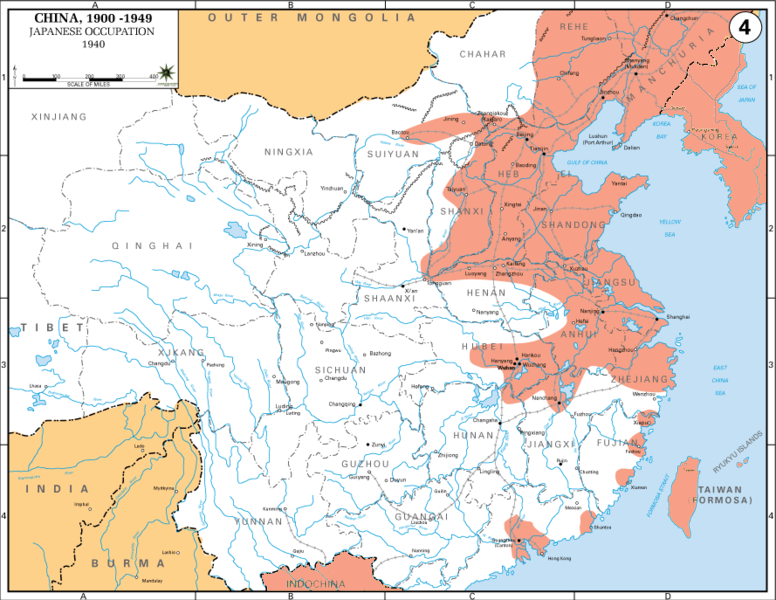 |
Above: Rose-colored shading marks the extent of Japanese-held China in 1940.
 |
 |
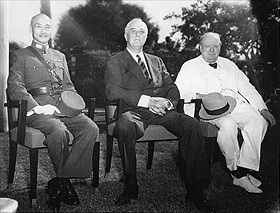
Left: Wang Jingwei’s adversaries: Nationalist Chinese leader Generalissimo Chiang Kai-shek, U.S. President Franklin D. Roosevelt, and British Prime Minister Winston Churchill at the Cairo (Egypt) Conference, November 25, 1943. Chiang Kai-shek’s Nationalist government as well as his Communist Party rivals denounced Wang for being a Japanese collaborator (Nationalist viewpoint) and being anti-communist (Communist viewpoint).
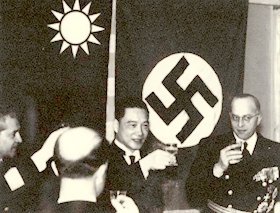
Right: Wang Jingwei (1883–1944) toasts the German ambassador to Nanjing, Heinrich Georg Stahmer, 1941 or 1942. Wang’s regime flew the same flag as Chiang Kai-shek’s Nationalist Chinese. In 1943 Stahmer moved to Tokyo to head the German embassy there. When Germany capitulated to the Allies in May 1945, the Japanese interned Stahmer. When Japan capitulated in September 1945, Stahmer was interned by the Americans, who released him in Germany in 1948. At the end of the Sino-Chinese war, Chiang Kai-shek moved his Nationalist capital back to Nanjing, destroyed Wang’s grave, and burned Wang’s body.
American John Magee: His Lone Camera Recorded the Tragedy of Nanjing Massacre

World War II was the single most devastating and horrific event in the history of the world, causing the death of some 70 million people, reshaping the political map of the twentieth century and ushering in a new era of world history. Every day The Daily Chronicles brings you a new story from the annals of World War II with a vision to preserve the memory of those who suffered in the greatest military conflict the world has ever seen.