

SUICIDE PILOTS MAKE LETHAL SHOW
U.S. Navy Offshore Okinawa, Ryukyu Islands · March 26, 1945
Late in 1944 Rear Admiral Takajiro Ohnishi, commander of the First Air Fleet in Japanese-held Manila, the Philippine’s capital, championed a special attack force (tokubetsu kogeki tai, abbreviated as tokkotai) that would inflict maximum damage on Allied naval vessels squeezing the island empire: Japan’s food supply and fuel reserves were scraping the bottom, which is also where her once-vaunted fleet lay. A chief tactic in Ohnishi’s strategy involved loading high explosives onto land-based aircraft that would be flown by youthful, mostly inexperienced naval aviators who reputably gloried in self-sacrifice as they crashed their planes into Allied ships to sink or cripple them and kill as many sailors and Marines as possible. These one-way tokkotai pilots had been named after a “Divine Wind,” a kamikaze, that destroyed a Mongol invasion fleet centuries earlier, saving Japan from conquest. Ohnishi hoped to repeat his ancestors’ fate by using these one-way aviators in what were euphemistically called “special attack formations.”
On this date, March 26, 1945, the first kamikazes participated in the Okinawa campaign, the last major action of the Pacific War. In doing so they tipped the Allies off that their Operation Iceberg, the April 1 amphibious invasion of Okinawa, 340 miles from the Japanese homeland and its last line of defense, would face serious and relentless suicide opposition. The Allies did their best to put into place shipboard antiaircraft defenses, dispatch destroyer radar pickets on the fleet’s perimeter, and form radar-directed combat air patrols. Still swarms of kamikaze suicide planes extracted a heavy toll in April. A day before the invasion launch date one death diver crashed his plane into the USS Indianapolis, the flagship of Adm. Raymond Spruance, who was the overall Allied naval commander of the U.S. Fifth Fleet and the newly formed British Pacific Fleet.
On April 6–7 a typhoon of more than 700 Japanese aircraft, fighter planes, and conventional bombers assaulted the Allied fleet and overwhelmed its defenses. It was 19 hours in kamikaze hell. The tally of enemy aircraft shot down during this period was reckoned at 304 by American sources. Japanese sources concede that none of the fighter planes returned home, while admitting that conventional bomber losses are unknown. In all, 1,465 large-scale kamikaze attacks launched from Kyūshū, the southernmost Japanese Home Island, were made off Okinawa between March and June 1945. Roughly one in five or one in seven (sources vary) kamikaze pilots found their target and their death (about 3,800 pilots). Of the 1,400 Allied ships and vessels that took part in the Okinawa campaign (April 1 to June 21, 1945), 34 (or 36) were sunk (6 warships in the hellish hours of April 6–7), chiefly destroyers; 368 vessels were damaged, including 8 carriers. More than 400 fleet aircraft were lost. Over 4,900 or likely as many as 7,000 U.S. and Allied sailors were killed or went missing in action, with an additional 4,824 injured. Nearly one in five U.S. Navy casualties suffered during the war came off the coast of Okinawa. This was by far the heaviest loss incurred in any naval campaign in the war. Overall, however, the losses kamikaze pilots inflicted on the Allied fleet off Okinawa were insufficient to turn the tide of war in Japan’s favor, although they did raise the price of America’s eventual victory.
A final word. From a Japanese perspective it is worth pointing out that the typical Japanese person then and now rejects the term “suicide attack” when speaking of kamikaze. The kamikaze pilot did not begin his one-way mission with the intention of committing suicide. He considered himself a pilot-guided lethal bomb that would cripple or destroy a certain part of the enemy fleet for his emperor and country similar to the fate that befell the Mongol invasion fleet centuries earlier. His was a glorious act, while suicide may or may not be.
Japanese Kamikaze Pilots—Ten-Month Scourge of the U.S. Fleet
 |
 |
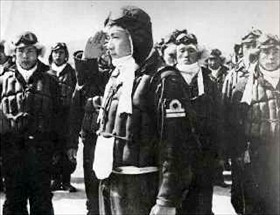
Left: A Japanese Navy kamikaze pilot in the rank of a lieutenant receives sortie orders. Three-quarters of the 4,000 Japanese pilots who died in the last 18 months of the war, many in kamikaze missions, were “boy pilots,” teenagers barely out of school. Another thousand were university draftees. Most Japanese, especially the well-educated student soldiers and aviators, knew well before 1944 that Japan was going to lose the war. The cruel and futile kamikaze operation was the last desperate hurrah for Japan’s military leaders and their emperor Hirohito.
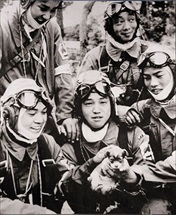
Right: Seventeen-year-old Cpl. Yukio Araki, holding a puppy, with four other pilots of the 72nd Shinbu Squadron based on Kyūshū. Araki died the following day, May 26, 1945, in a lethal attack on ships near Okinawa. Between April 6 and June 22, Kyūshū launched 1,465 kamikaze aircraft in large-scale attacks and 185 individual kamikaze sorties. From a Japanese perspective it is worth pointing out that the typical Japanese person then and now rejects the term “suicide attack” when speaking of kamikaze. The kamikaze pilot did not begin his one-way mission with the intention of committing suicide. He considered himself a pilot-guided lethal bomb that would cripple or destroy a certain part of the enemy fleet for his emperor and country similar to the fate that befell the Mongol invasion fleet centuries earlier. His was a glorious act, while suicide may or may not be.
 |
 |
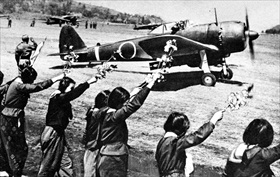
Left: High school girls wave farewell with cherry blossom branches to 2nd Lt. Toshio Anazawa of Army Special Attack Unit (20th Shinbu Squadron). The aircraft, an Army Type 1 fighter carrying a 550 lb/250 kg bomb, departs for Okinawa on April 12, 1945.
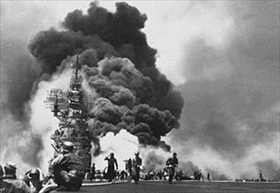
Right: USS Bunker Hill was hit on May 11, 1945, by 22-year-old kamikaze pilot Ensign Kiyoshi Ogawa and another airman 30 seconds apart. From a carrier crew of 2,600, 389 personnel were killed or went missing and 264 were wounded. Although suicide attacks on the heavy cruiser Indianapolis and the carrier Bunker Hill are relatively well-known, toward the end of the naval battle off Okinawa the radar picket ships on the edge of the fleet became the prime kamikaze targets. Of the 206 ships serving radar picket duty, 29 percent were sunk or damaged in Japanese air attacks, making theirs the most hazardous but least known naval surface duty of the war.
Allied Sea Power Threatened by New Military Tactic at Okinawa: Japanese Kamikaze Pilots

World War II was the single most devastating and horrific event in the history of the world, causing the death of some 70 million people, reshaping the political map of the twentieth century and ushering in a new era of world history. Every day The Daily Chronicles brings you a new story from the annals of World War II with a vision to preserve the memory of those who suffered in the greatest military conflict the world has ever seen.