

“BIG WEEK” KICKS OFF IN SKIES OVER GERMANY
London, England · February 20, 1944
On this date in 1944, while Soviet armed forces were ridding their country of the German Wehrmacht on the Eastern Front, U.S. and British air forces embarked on Operation Argument in the skies over the Western Front. Unofficially dubbed “Big Week,” Operation Argument was an intensive 6‑day air campaign that targeted factories, airfields, railroad classification (or marshalling) yards, and other strategic facilities involved in German aircraft production. More than 1,000 U.S. bombers pinballed across Germany, striking aircraft factories in the Braunschweig (Brunswick) and Leipzig areas on this first day. Collaborating with the Royal Air Force (which bombed at night), the U.S. Eighth and Ninth Air Forces (based in Britain) and the Fifteenth Air Force (based in Italy), flying by day, undertook the bulk of the bombardments, dropping roughly 10,000 tons of bombs in 3,500 sorties during Big Week.
The Americans paid a heavy price—226 bombers alone were downed, 21 the first day while a further 290 were damaged. Crew losses among the Eighth Air Force were 83 killed, 103 wounded, and over a thousand missing. The RAF lost 131 bombers and crews. Combined, the 2 Allied air forces lost roughly six percent of their planes and crews. But Hermann Goering’s Luftwaffe paid a heavier price, as Allied B‑17 Flying Fortresses and B‑24 Liberators, escorted by long-range P‑38 Lightnings, P‑47 Thunderbolts, and the new P‑51 Mustangs, downed hundreds of German aircraft. For the most part the Luftwaffe’s twin-engine fighter groups were destroyed along with 100 single-engine pilots and planes, or almost 20 percent of the Luftwaffe’s day-fighter force. More and more, the ranks of German fighter pilots were being filled by inexperienced airmen forced to fly missions they were not prepared for.
Another consequence of Big Week was that German fighter squadrons were forced to redeploy from the Eastern and Western fronts to protect the German heartland and its strategic war industries. German fighter redeployment from France to Germany would have important repercussions later that spring, for Goering’s Luftwaffe was impotent when it came to hurling Allied forces off Normandy’s invasion beaches. The outcome of the land war in the west was still up for grabs in June 1944, but 3 months earlier the outcome of the air war was no longer in doubt.
“Big Week,” February 20–25, 1944, Achieved Allied Air Superiority in Europe
 |
 |
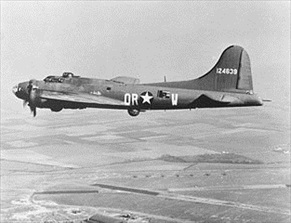
Left: A Boeing B-17F Flying Fortress in flight. A total of 12,731 Flying Fortresses were built between 1935 and 1945. B‑17s flew with the U.S., British, and Soviet air forces. The German Luftwaffe even flew a dozen captured ones. B‑17s were armed with 13 .50 caliber/12.7 mm M2 Browning machine guns in 8 positions. Depending on the distance of the mission, the B‑17 could carry between 4,000 and 8,000 lb/1,814 and 3,629 kg of bombs. More bombs were dropped by B‑17s than by any other U.S. aircraft in World War II. Of the 1.5 million metric tons of bombs dropped on Nazi Germany and its occupied territories by U.S. aircraft, 640,000 tons were dropped from B‑17s.
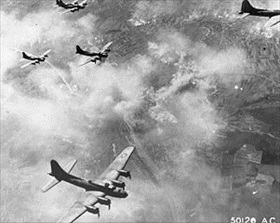
Right: 1st Bomb Wing B-17s over Schweinfurt, Germany, August 17, 1943, 6 months before “Big Week.” The Schweinfurt-Regensburg mission entailed 2 large forces of U.S. Eight Air Force bombers (376 bombers in 16 bomb groups) attacking separate targets in order to disperse German fighter aircraft reaction. The “double-strike mission” deep inside Germany inflicted heavy damage on the Regensburg target but not the Schweinfurt one, for a catastrophic loss to the force: 60 bombers shot down, 87 shot up beyond repair, and 557 airmen missing in action or captured. A planned follow-up raid on Schweinfurt had to be postponed to rebuild American forces. The second raid by 291 still-unescorted B‑17s on October 14, 1943, on the ball-bearing production center at Schweinfurt proved even more catastrophic: 77 bombers lost, 121 damaged, and over 650 crewmen captured or killed.
 |
 |
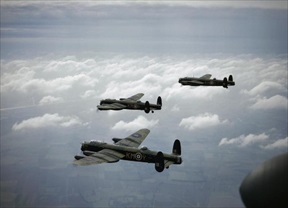
Left: Three Avro Lancasters. The “Lanc” first saw active service with RAF Bomber Command in 1942 and, as the strategic bombing offensive over Europe gathered momentum, it became the main heavy bomber used by the RAF and squadrons from other Commonwealth and European countries serving within the RAF. A total of 7,377 of these 4-engine bombers were built, delivering over 680,000 tons of bombs in 156,000 sorties. Using a mixed force of Lancasters and 4‑engine Handley Page Halifaxes (in service in the fall of 1940), the RAF dropped 2,000 tons of bombs on Schweinfurt on the night of February 24, 1944. Earlier in the day a collection of long-range U.S. fighter escorts and 238 bombers pulverized Schweinfurt.
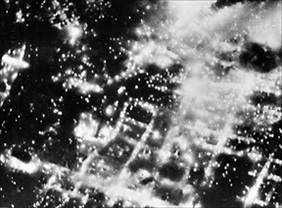
Right: Braunschweig, whose industrial sector was targeted during “Big Week,” was completely laid to waste by the RAF on the night of October 14/15, 1944, in an operation that rivaled the firebombing of Hamburg (Operation Gomorrah) the year before. The city burned continuously for 2½ days.
RAF Avro Lancaster, the Most Famous and Successful World War II Night Bomber

World War II was the single most devastating and horrific event in the history of the world, causing the death of some 70 million people, reshaping the political map of the twentieth century and ushering in a new era of world history. Every day The Daily Chronicles brings you a new story from the annals of World War II with a vision to preserve the memory of those who suffered in the greatest military conflict the world has ever seen.