

NORWAY’S KING, GOVERNMENT FLEE TO ENGLAND
Tromsø, Occupied Norway · June 7, 1940
Within days of the German invasion of Denmark and Norway on April 9, 1940, it became clear that the Norwegian armed forces could not resist the more powerful Wehrmacht (German armed forces), bristling with modern weaponry and supported by highly effective air cover. Caught largely by surprise, the military’s initial defense in the south of Norway was largely disorganized and ineffectual, though sufficient to allow King Haakon VII and his government to escape capture. A solution along the lines achieved in Denmark, which capitulated to the Germans on Day 1, would appear to spare the nation many deaths and much destruction. Nevertheless, an organized and spirited military defense and counterattacks in parts of western and northern Norway began, aimed at securing strategic positions along the coast with the help of British, French, and Polish forces. The Nazi invasion of France, which managed to corner the broken remains of the French army and the British Expeditionary Force in the Dunkirk pocket, knocked that plan into a cocked hat. On this date in 1940 the Norwegian government held its last meeting on Norwegian soil in Tromsø nearly 200 miles north of the Arctic Circle and far from the nearest German lines. A few hours later the king, crown prince, members of the government, and the diplomatic corps—a total of 400 passengers—boarded the British heavy cruiser HMS Devonshire for exile in England. All serviceable Norwegian naval vessels, aircraft with adequate range, and merchant ships joined the exodus. Late the next night the order to demobilize the remaining Norwegian armed forces was issued. The Germans did not interfere. The German and northern Norwegian commands signed a ceasefire on June 10, 1940. The ceasefire did not prevent Norway’s legitimate government—now operating out of London—from continuing the struggle as a member of the Allies against the German invaders. Most Norwegians remained loyal to their king, and patriots did not hesitate to ridicule Vidkun Quisling (1887–1945) and his collaborationist government in Oslo. (The word “Quisling” entered the English language as a synonym for “traitor.”) The Milorg resistance movement, which began life as a small sabotage unit but ended up as a 40,000-strong military force, played a crucial role in forcing German capitulation in Norway in May 1945 and in stabilizing the country during the postwar years.
[fblike]
[amazon_carousel widget_type=”ASINList” width=”600″ height=”200″ title=”Recommended Reading” market_place=”US” shuffle_products=”False” show_border=”False” asin=”1935149334,1848326610,0521041155,1846031176,0803277873,156980141X,1425177271,1599210630,1591143233,1599213214″ /]
Norwegian Resistance to Nazi Occupation, 1940–1945
 |
 |
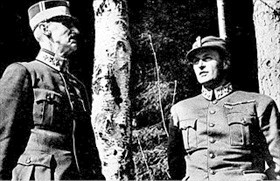
Left: Norwegian King Haakon VII and Crown Prince Olav sought shelter in the area of Molde on the country’s west coast during a German bombing of the town in April 1940. The Luftwaffe endeavored to kill the king, the royal family, and members of the legitimate Norwegian government after their successful escape from Oslo in the aftermath of the German invasion of Norway. The king, his family, and his government were conveyed by a British cruiser 600 miles north to Tromsø, where they established a provisional capital on May 1, 1940.
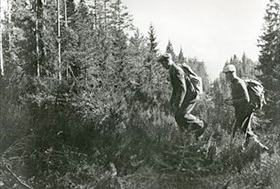
Right: Norwegian refugees cross the border into Sweden. Throughout the war years, a number of Norwegians fled the Quisling regime. These included Norwegian Jews, political activists, and others who had reason to fear for their lives. Border patrols were established to stop these flights across the long border with Sweden, but locals who knew the woods found ways to bypass them.
 |
 |
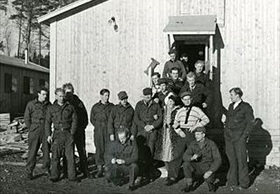
Left: Although neutral, Sweden surreptitiously aided the Norwegian resistance movement with training and equipment in a series of camps set up in mid-1943 along the Norwegian border. To avoid suspicion, the Swedes camouflaged the camps as police training camps. Funding came from the Norwegian exile government in London. By 1944, some 7,000–8,000 men had been trained in Sweden. After the German capitulation in Oslo in May 1945, around 13,000 police troops were transferred to Norway to help bring security and stability to the new government.
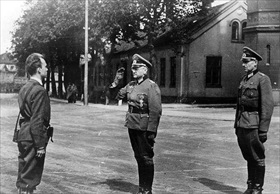
Right: Col. Terje Rollem, Milorg district chief for Oslo, carried only a handgun as he assumed command of Akershus Fortress on behalf of the Norwegian resistance, May 11, 1945. The handover occurred in front of the German commandant’s residence. Rollem and the commandant’s adjutant (right in photograph) walked around the castle grounds, substituting Milorg men for German guards, who were taken to a POW camp. This iconic photo came to be displayed in homes all across Norway as a symbol of the country’s liberation.
German Invasion and Occupation of Norway, Norwegian Resistance, and Liberation

World War II was the single most devastating and horrific event in the history of the world, causing the death of some 70 million people, reshaping the political map of the twentieth century and ushering in a new era of world history. Every day The Daily Chronicles brings you a new story from the annals of World War II with a vision to preserve the memory of those who suffered in the greatest military conflict the world has ever seen.