

HITLER INVADES AUSTRIA
Linz, Austria · March 12, 1938
After abolishing the Ministry of War on February 4, 1938, and creating in its place the Oberkommando der Wehrmacht (OKW, or Supreme Command of the Armed Forces) with himself at its helm, Adolf Hitler now focused on a peaceful takeover of Europe beginning with his native Austria. (Hitler was born in Braunau near Linz, the Upper Austrian provincial capital.) In mid-February 1938 Hitler invited Austrian Chancellor Kurt Schuschnigg to meet him halfway, at the Berghof in Bavaria, the Fuehrer’s luxurious vacation residence. Schuschnigg wanted to use the meeting with his German counterpart to reaffirm Austria’s independence of its powerful neighbor. Hitler, in the company of three German generals (one being, in Hitler’s words, one of his “two most brutal-looking generals”), used the meeting to browbeat Schuschnigg into joining with him in creating a Greater German Reich (Großdeutschland) through Anschluss (union) with Germany. “Perhaps I’ll appear sometime overnight in Vienna; like a spring storm. Then you’ll see something,” he warned Schuschnigg. The Austrian chancellor returned home more determined than ever to avoid a German embrace. Schuschnigg proposed a national referendum over the issue of Anschluss, to take place on March 13, 1938. Hitler, afraid that the vote would be unfavorable to pro-Nazi Austrians, many of whom Schuschnigg and his predecessor in office had jailed, ordered German troops into Austria on this date in 1938, the eve of the referendum, to enforce Anschluss. On that same day Hitler made a triumphal entry into Linz, his “hometown.” An ad hoc Einsatzkommando (task force) formed by Reinhard Heydrich, psychopathic chief of both the Sicherheitsdienst (SD), or Security Service, and the Sicherheitspolizei (SiPo), or Security Police, which comprised in part the notorious Geheime Staatspolizei (Gestapo, Secret State Police), secured Austrian government buildings and documents and interrogated senior civil servants. Schuschnigg was arrested and deported. (Schuschnigg spent most of the war years in two different Nazi concentration camps, first Sachsenhausen, then Dachau.) Austrian Nazis held a sham plebiscite the following month, asking voters to ratify the fait accompli. The electorate allegedly voted 99.73 percent in favor of Anschluss. Austria became known as Ostmark, “the Eastern Region.”
[fblike]
[amazon_carousel widget_type=”ASINList” width=”600″ height=”200″ title=”Recommended Reading” market_place=”US” shuffle_products=”False” show_border=”False” asin=”1935149121,1602392463,1586177095,0785826653,1616086084,0300187726,019966921X,0307742601,1616144742,0807853631″ /]
German-Austrian Anschluss, 1938
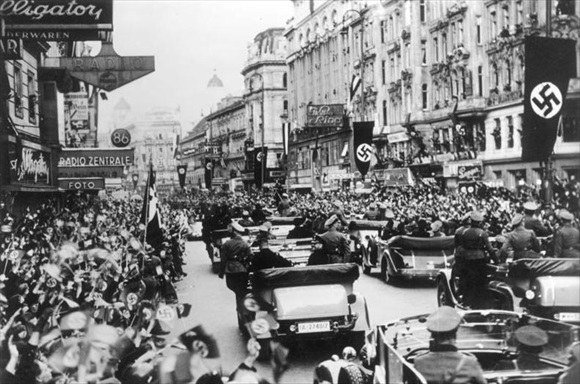 |
Above: Hundreds of thousands of Austrians lined the streets as Hitler and his entourage made a triumphal entry into Austria’s capital, Vienna, on March 14, 1938.
 |
 |
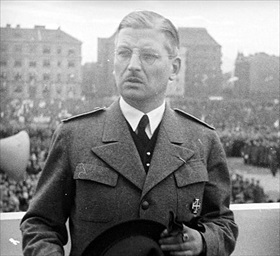
Left: Austrian Chancellor (1934–1938) and Fatherland Front leader Kurt Schuschnigg at a party rally, 1936. Schuschnigg rejected Hitler’s Pan-German politics; instead, he focused on protecting Austria’s independence during a decade of political unrest in Central Europe. After the war and his release from German captivity, Schuschnigg emigrated to the U.S., where he taught political science at Saint Louis University in Missouri from 1948 to 1967. Schuschnigg returned to Austria where he died in 1977.
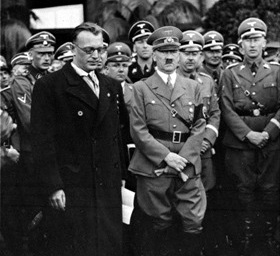
Right: Nazi Reich Governor Arthur Seyss-Inquart with Hitler in Vienna, 1938. (Heydrich is behind Hitler and to his left.) During their February 1938 meeting at the Berghof, Hitler bullied Schuschnigg into appointing Austrian Nazi Party leader Seyss-Inquart to head Austria’s Ministry of Public Security, a sensitive post that gave Austrian Nazis full and unlimited control of their country’s police forces. With the assistance of Seyss-Inquart’s post-Anschluss puppet government, the Nazis quickly embarked on a campaign of repression and terror. Tens of thousands of Austrians, including Catholics, Social Democrats, Socialists, and Communists, were arrested and sent to concentration camps.
Hitler’s Entry into Austria, March and April 1938. Also clips of Hitler and Benito Mussolini in Nuremberg, Germany, September 1937

World War II was the single most devastating and horrific event in the history of the world, causing the death of some 70 million people, reshaping the political map of the twentieth century and ushering in a new era of world history. Every day The Daily Chronicles brings you a new story from the annals of World War II with a vision to preserve the memory of those who suffered in the greatest military conflict the world has ever seen.