

HITLER BECOMES GERMAN CITIZEN
Munich, Germany · February 26, 1932
On this date in 1932 in Germany, Austrian-born Adolf Hitler was granted German citizenship. A decade earlier the Austrian was the unlikely leader of a fringe Populist-nationalist movement, the National Socialist German Workers’ Party. In November 1923 he led a “beer-hall putsch” in the Bavarian capital, Munich, hoping to spur dissatisfied elements in the German army to bring down the national government in Berlin, the so-called Weimar Republic. The putsch was immediately suppressed by Bavarian authorities. Hitler was arrested and sentenced to five years in Bavaria’s Landsberg prison for high treason. In a comfortable cell he dictated his crackpot autobiography, Mein Kampf, to fellow inmate Rudolf Hess and polished his already considerable oratorical skills. In late December 1924 Bavarian authorities, pressured by Hitler’s supporters, pardoned and released their prisoner early “for good behavior.” Six years later, in 1930, the ex-convict and his National Socialist (Nazi) party had emerged as key players in shaping a coalition government under German President Paul von Hindenburg. The World War I hero, a living, wheezing link to Germany’s glory days under the Kaiser, despised “that Bohemian corporal.” Hitler’s aptitude, the former Field Marshall said, would consign him at best to being a lowly postmaster general. With newly minted citizenship and the right to hold public office in Germany, Hitler could command a high cabinet post now that his party, following the July 1932 elections, controlled a relative majority of parliamentary seats in the Reichstag (German parliament). Though the Nazis lost seats in November that year, Hindenburg ate his words and appointed the 43-year-old former corporal to the second highest office in the land, that of German Chancellor, on January 30, 1933. Hindenburg hoped that the moderate members of Hitler’s cabinet, in which Hitler’s National Socialists were a minority, would act as a restraining influence on the powerful new political leader. But within months Hitler had turned tables on the German president. Shortly after the Reichstag building erupted in flames on the night of February 27, 1933, Hitler assumed absolute power through a series of Enabling Acts signed by the doddering Hindenburg. In August 1934 Hindenburg succumbed to old age and Germany’s parliamentary system of representative government (or what was left of it) succumbed, in turn, to Hitler, leaving the Nazi leader at the helm of a nation he steered toward bestial savagery, genocidal war, and apocalyptic ruin.
[fblike]
[amazon_carousel widget_type=”ASINList” width=”600″ height=”200″ title=”Recommended Reading” market_place=”US” shuffle_products=”False” show_border=”False” asin=”0312233515,0674350928,098836820X,0143034693,0201328003,1616086084,0807847216,0674952006,0275954854,143919100X” /]
Hitler and His Nazi Supporters Attempt to Seize Control of the Bavarian State Government, November 8–9, 1923
 |
 |
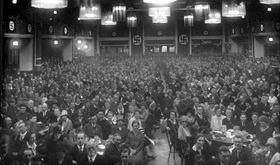
Left: A 1923 gathering of National Socialist German Workers’ Party members in the Buergerbraeukeller, a Munich beer hall. Large beer halls in southern Germany were popular gathering places for local politicians, the general public, and spirited debate. Between 1920 and 1923, the Nazis were fond of holding party rallies at the Buergerbraeukeller because it could accommodate over 1,800 people.
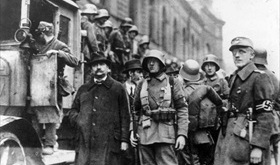
Right: A Nazi strike team (Stosstrupp), shown in this photo from November 9, 1923, took nine Munich City Council members hostage and locked them up in the Buergerbraeukeller. Munich was to have been the base for Hitler and his associates to march on Berlin to bring down Germany’s Weimar Republic government.
 |
 |
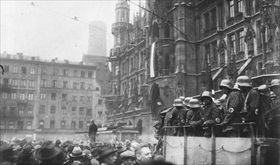
Left: Munich’s Marienplatz and the Rathaus during the failed Beer Hall Putsch, November 9, 1923. Around two thousand men, some armed and transported in trucks, assembled on Marienplatz.
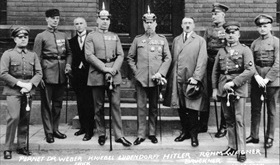
Right: Group photo of the participants of Munich’s Beer Hall Putsch (also known as the Hitler-Ludendorff Putsch) stand in front of a Bavarian courthouse, accused by authorities of high treason. Hitler in civilian attire, hat in left hand, stands to the left of Gen. Erich Ludendorff, a prominent nationalist leader during the Weimar Republic. Photo taken by Heinrich Hoffmann, Hitler’s personal photographer, April 1, 1924.
Hitler’s Brazen Beer Hall Putsch, November 1923

World War II was the single most devastating and horrific event in the history of the world, causing the death of some 70 million people, reshaping the political map of the twentieth century and ushering in a new era of world history. Every day The Daily Chronicles brings you a new story from the annals of World War II with a vision to preserve the memory of those who suffered in the greatest military conflict the world has ever seen.