

WOMEN RECRUITED INTO GERMAN MILITIA
Berlin, Germany · February 12, 1945
On this date in 1945 German women were called up for service in the Volkssturm (national militia). Adolf Hitler was playing his final card in World War II by mobilizing practically every German civilian for an apocalyptic defense of the Third Reich, a 20th-century Wagnerian Goertterdaemmerung. Nazi themes of death, transcendence, and commemoration were given full play to encourage recruitment into a lost cause. The previous year, 1944, German military fortunes, reduced by advancing enemy armies on both eastern and western fronts, compelled the nation to conscript 16-year-olds from the Hitlerjugend (Hitler Youth) to fill the ranks of its understrength infantry units. In late-September of that year male conscription was extended to those up to the age of 60. Dozens of Volkssturm battalions were formed from among citizens who were not already serving in a military unit. Into their hands were placed Panzerfaust antitank weapons for the last-ditch campaign against the advancing enemy. Lacking uniforms, these former civilians were issued black armbands embossed with the words Deutscher Volkssturm Wehrmacht, supposedly to give them a semblance of belonging to the Wehrmacht (German armed forces). (The armbands did not prevent Soviet soldiers from treating these armed men, out of military uniform, as bandits and therefore undeserving of a chance to surrender.) From the outset the Volkssturm was subject to the authority of Nazi Party Gau– and Kreisleiter (county and district leaders), not officers of the Wehrmacht, except in battle. In this final call-up, the Nazi Party exerted even more pressure on civilians than before, and so-called “volunteers” who would otherwise have been exempted by their age or sex were conscripted under the threat of summary execution of any citizen shirking his or her duty to defend the Vaterland. In the final major offensive of the war, the Battle of Berlin (April 16 to May 2, 1945), 40,000 members of the Volkssturm (mainly veterans of World War I and young boys between the ages of 13 and 18 who had grown up surrounded by Nazi propaganda) were used by the German high command in their desperate, senseless, and futile defense of Hitler’s capital.
Volkssturm, Hitler’s Last Desperate Defense Force, 1944–1945
 |
 |
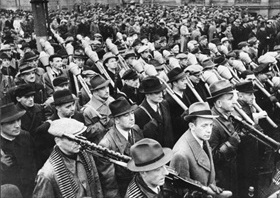
Left: Carrying weapons and ammunition, men of the Volkssturm parade past the Gauleiter of Berlin and Reich Minister for Public Enlightenment and Propaganda Joseph Goebbels, Berlin, November 12, 1944. The parade was part of a solemn swearing-in ceremony of Volkssturm volunteers as much as a national morale booster to shore up sagging defenses. Just the month before, on October 18, 1944, Hitler had ordered the Volkssturm into existence in a desperate measure to use all available manpower to delay Germany’s inevitable defeat.
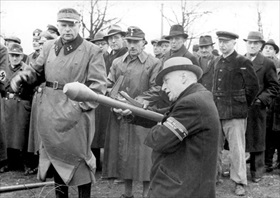
Right: An elderly member of the Volkssturm being taught to use the Panzerfaust, Berlin, March 21, 1945, less than a month before the Soviet assault on “Fortress Berlin.” In many cases Volkssturm members fought bravely in close combat against overwhelming odds, but the lives of tens of thousands of poorly equipped and half-trained elderly men and young boys were tragically wasted by throwing them into a last-ditch battle with combat-tested Allied soldiers when the war was already lost.
 |
 |
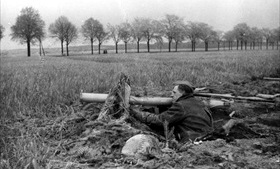
Left: A Volkssturmmann ready to fire a Panzerschreck, a two-man antitank weapon. Undermined by a visible lack of uniforms (individuals supplied their own clothing), battle weaponry (it was a hodge-podge), training in its use, and low morale (there was no remuneration for Volkssturm service except when a member took part in combat), the intended strength of six million Volkssturm conscripts never materialized. A U.S. intelligence estimate in early 1945 was that less than half of the rag-tag organization was physically fit.
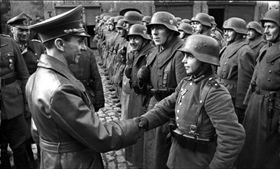
Right: In mid-March 1945 Goebbels visited the Eastern Front, where 16-year-old Willi Huebner, a messenger with the Fuehrer Grenadier Division, took part in a German counterattack to retake the Silesian town of Lauban (today’s Lubań, Poland) earlier that month. Goebbels, photographers in tow, congratulated the boy-soldier, all spiffed up in helmet and uniform, for receiving the Iron Cross 2nd Class days earlier. Huebner can be seen a third of the way into the video below, in which he is congratulated by none other than Hitler himself in the ruined gardens of the Reich Chancellery, describing his responsibilities during the retaking of Lauban. Huebner survived the war and appeared in several documentaries about fighting on the Eastern Front.
Defending the Reich to the Last Man: Last German Newsreel from 1945 (in German)

World War II was the single most devastating and horrific event in the history of the world, causing the death of some 70 million people, reshaping the political map of the twentieth century and ushering in a new era of world history. Every day The Daily Chronicles brings you a new story from the annals of World War II with a vision to preserve the memory of those who suffered in the greatest military conflict the world has ever seen.