

UNITED STATES IMPOSES PEACETIME DRAFT
Washington, D.C. • September 16, 1940
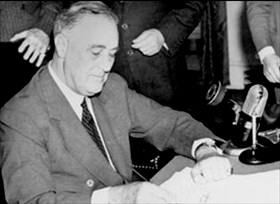
On this date U.S. President Franklin D. Roosevelt signed the nation’s first peacetime draft law—the Selective Training and Service Act, also known as the Burke-Wadsworth Act. Created to conscript troops quickly in the event the U.S. was drawn into a second global war, the new law was in response to looming geopolitical tensions around the world. In the 1930s Italy invaded and annexed Ethiopia, incorporating the African kingdom into its colony of Italian East Africa; Spain lay prostrate on account of a nasty conflict between republicans and fascists and their outside enablers; and Germany invaded its eastern neighbor Poland at the end of the third decade and, as a consequence, was at war with Poland’s military allies, Great Britain and France. On the other side of the globe the entire Asia Pacific region stood on the brink of a wider war, the result of Imperial Japan embarking on new conquests on the Chinese mainland, in Indochina (present-day Vietnam, Laos, and Cambodia), and soon it was feared in Southeast Asia/Oceania (Dutch East Indies, today’s Indonesia).
Similar to America’s World War I draft of 1917, Roosevelt’s 1940 registration and conscription act provided a “selective” draft that ranked liable American males and some resident aliens by class and subclass. Under the 1940 act able-bodied men, though not women, were drafted initially into the army and later into the navy, Marine Corps, and Coast Guard by class and individual case. Draft-age men could potentially avoid military service if they were employed in agriculture, mining, business, commerce, shipbuilding and defense-related industries, and other essential occupations that supported the efforts of the U.S. military and the civilian economy.
All males between the ages of 21 and 35 inclusive were required to register for selective service at their local or district draft boards. A national lottery was used to draft servicemen. The first draftees entered service on November 18, 1940. Voluntary enlistments were handled by the same civilian draft boards. Deferments or exemptions from conscription requirements were given to liable males on an individual basis. Exemptions were provided for conscientious objectors (noncombatant military service or alternative service of national importance for no compensation), for most Nisei (second-generation Japanese Americans) between December 1941 and January 1944, for black Americans for most of the war years because of racist assumptions about their fighting abilities, and for Americans with a wide range of acquired and congenital conditions (see photo essay below). States and territories were given conscription quotas based on the number of registrants in their jurisdictions who were identified by their draft boards as available for military service and were found acceptable by one of the military branches.
In late December 1941 the age bracket expanded to 18 through 64 years of age. However, immediate induction typically focused on younger age groups, primarily 18 to 45; men aged 45 to 64 were conscripted mainly for manpower and skills inventory, not direct combat. The restriction that draftees could not serve outside the Western Hemisphere or the nation’s possessions or territories was dropped 6 days after Japan’s bold surprise move against U.S. naval and air installations on the Hawaiian Islands on December 7, 1941. Some 16.5 million men were registered during the first registration effort ending on October 16, 1940, the first of 7 mass registrations. Between November 1940 and October 1946 over 45 million men were registered, of which 15 million served in the armed forces. Over 10 million men, or roughly 66 percent who served in uniform, were inducted through the Selective Service System out of about 19 million men drafted. (Altogether 16.4 American men and women served in World War II.) Roosevelt’s 1940 draft law was allowed to expire on March 31, 1947, to be replaced by a new Selective Service regime a year later.
Selective Service: Civic Obligations in World War II
 |
 |
Left: President Franklin Roosevelt signed into law the Selective Training and Services Act of 1940 in the Oval Office on September 16. The law established a nationally uniform conscription process predicated on a nationwide lottery (later by birth date) and a series of classes (I–IV) and subclasses (A–H) applied to men between the ages of 21 and 35 (later 18 to 64) considered eligible for “combatant training and service in the land or naval forces of the United States.” Local and district draft boards were given original jurisdiction over all classifications, and appeals to conscription were permitted. Selection and deferment on an individual basis were designed to minimize disturbances to the nation’s economy.
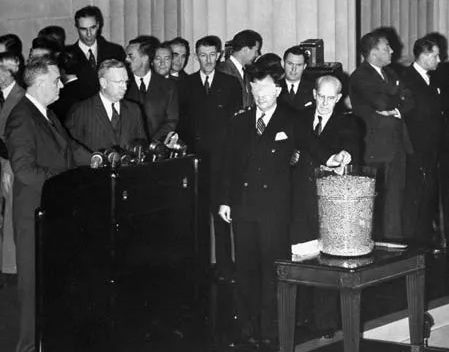
Right: On October 29, 1940, Secretary of War Henry Stimson drew the first number in the nation’s first peacetime draft lottery from the same 10-gallon glass fishbowl that had been used in the nation’s 1917 wartime draft. Stimson handed the number, 158, to President Franklin Roosevelt to read over the radio. The nation’s first peacetime draft had begun. Across the country, 6,175 young men held draft registration No. 158. The second number drawn, 192, was drawn by a different cabinet member, and so on. The men holding the first 10 percent of the lottery numbers drawn (there were close to 8,000 numbers in the fishbowl!) each received an “order to report for induction” from their draft boards based on their assigned number. After 3 national lotteries, call-up numbers were based on birth dates.
 |
 |
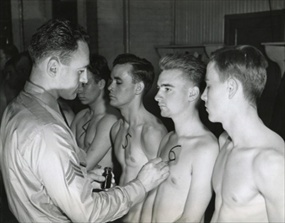
Left: Physical exams for fighting-age inductees and voluntary enlistees were multistage, starting with local or district draft board screenings for height, weight, vision, number of teeth, pulse rate, blood pressure, and overall health to determine initial eligibility. The men progressed to more demanding military medical boards at induction and reception centers that required chest X–rays, blood tests for venereal disease, and specific functional tests (pull-ups, push-ups, sit-ups, runs, burpees) and psychological screenings to gauge fitness for combat, general duty, or called for outright rejection due to significant dental, ear, throat issues, poor eyesight, flat feet, disease, or on moral grounds. Most physicals took place unclothed, men bearing numbers written on their chests as shown in this photo, the backs of their hands, or on placards hung around their necks. Men were placed into categories or classes, from Class I (best qualified; hence, first chosen to fill conscription quota), Class II and Class III (deferred because of occupation and/or dependency; hence, ranked second and third choices to fill conscription quota) to Class IV (limited service due to various physical or even educational factors [a half-million men had less than a fourth-grade education] or deemed “unfit for service” due to age, mental disability, race prejudice, illiteracy, or moral reasons; e.g., being homosexual or bisexual).
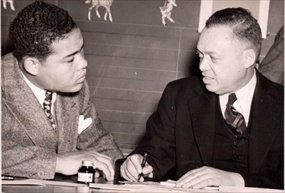
Right: This Associated Press wire photo shows 26-year-old heavyweight boxer Joe Louis registering at a segregated registration center in Chicago’s Hyde Park neighborhood for the military draft on October 16, 1940. The photo, captioned “He’s a fighter for you, Uncle Sam,” was circulated in practically every newspaper in the nation. Nicknamed the “Brown Bomber,” Louis enrolled under his given name, Joseph Louis Barrow. He was among almost a half million men who registered in Chicago on “R‑Day.” On January 10, 1941, Louis voluntarily enlisted in the Army as a private, eventually serving with the Special Services Division and assigned to an “entertainment and interracial relations morale mission.” He toured Army camps in the U.S., Europe, and North Africa, entertaining 2 million soldiers with boxing exhibitions. Louis’s income went from $100,000 for a few brief minutes of work to $21 a month. Other voluntary enlistees included Jimmy Stewart, Clark Gable, and Glenn Miller (U.S. Army Air Forces); John Basilone (U.S. Army and U.S. Marine Corps), Ira Hayes (U.S. Marine Corps); Ronald Reagan and Yogi Berra (U.S. Army); Paul Newman, Kirk Douglas, Gene Kelly, Tony Curtis, Henry Fonda, and John F. Kennedy (U.S. Navy); and Buddy Ebsen and César Romero (U.S. Coast Guard).
“Introduction to the Army,” U.S. War Department Official Training Film

World War II was the single most devastating and horrific event in the history of the world, causing the death of some 70 million people, reshaping the political map of the twentieth century and ushering in a new era of world history. Every day The Daily Chronicles brings you a new story from the annals of World War II with a vision to preserve the memory of those who suffered in the greatest military conflict the world has ever seen.