

26 REPS IN CAPITAL AFFIRM “UNITED NATIONS”
Washington, D.C. · January 1, 1942
On August 14, 1941, President Franklin D. Roosevelt and British Prime Minister Winston Churchill signed the Atlantic Charter on a warship off the Canadian coast. The two leaders hoped that, following the defeat of Adolf Hitler’s Germany, countries around the world would renounce the use of force in international relations and establish a permanent system of peace, freedom from fear and want, choice of government, and security for all.
On this date in 1942 Roosevelt, Churchill, Soviet Ambassador Maxim Litvinov, and Chinese Foreign Minister T. V. Soong (Soong Tse-ven) signed a short document (181 words) that later came to be known as the United Nations Declaration. The next day the representatives of twenty-two other nations added their signatures. This document contained the first official use of the term “United Nations,” which was suggested by Roosevelt to distinguish the Allied from the Axis, or Tripartite, wartime alliance. In the document the representatives vowed to employ all military and economic resources against the “savage and brutal forces seeking to subjugate the world.” Citing a common program of purposes and principles embodied in the Atlantic Charter, the nations vowed to defend life, liberty, independence, and religious freedom at home as well as elsewhere.
These aspirations were enshrined in the 111‑article Charter of the United Nations, which was officially adopted by the delegates of 50 nations at the San Francisco Conference on June 26, 1945, a month and a half before World War II ended with the surrender of the last Axis power, Japan. All the delegates hoped that the new U.N. organization would succeed where the old League of Nations had failed, in large part because the United States, the most powerful nation on earth after the First World War, had not joined the League. Nearly four months later, on October 24, 1945, the five permanent members of the Security Council, consisting of China, France, the Soviet Union, Great Britain, and the United States, along with a majority of other signatories, ratified the organization’s charter, and the U.N. officially came into existence.
[fblike]
[amazon_carousel widget_type=”ASINList” width=”600″ height=”200″ title=”Recommended Reading” market_place=”US” shuffle_products=”False” show_border=”False” asin=”1579129447,0700604855,0756642787,0307262839,0816079137,0764553526,0785824278,1426209703,0756651425,1556524552″ /]
New Year’s Day 1942, Birthday of the United Nations
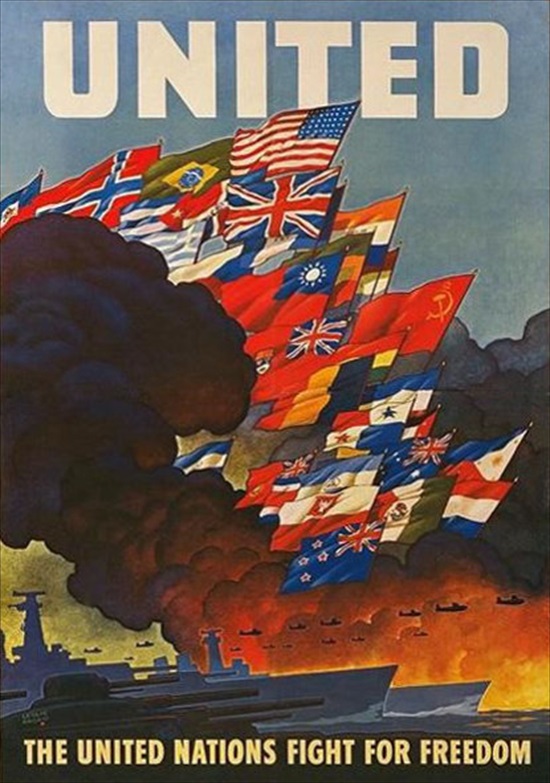 |
Above: Poster created in 1943 by the U.S. Office of War Information and printed by the U.S. Government Printing Office following the Declaration of the United Nations of 1942. The poster featured the flags of those countries or governments-in-exile (with the unusual exception of the Free French) that pledged to support the Allied war effort against the Axis powers. Beginning from the top-left corner and continuing in rows from left to right: Haiti, Norway, Brazil, the United States, Cuba, the Dominican Republic, the United Kingdom, Greece, Guatemala (behind the British flag), South Africa, Czechoslovakia, China, Ethiopia, Luxembourg, Canada, the Soviet Union, Belgium, Bolivia, Yugoslavia, Honduras, Panama, Iraq, India, Costa Rica, El Salvador, Australia, the Philippines, Poland, Mexico, the Netherlands, and New Zealand.
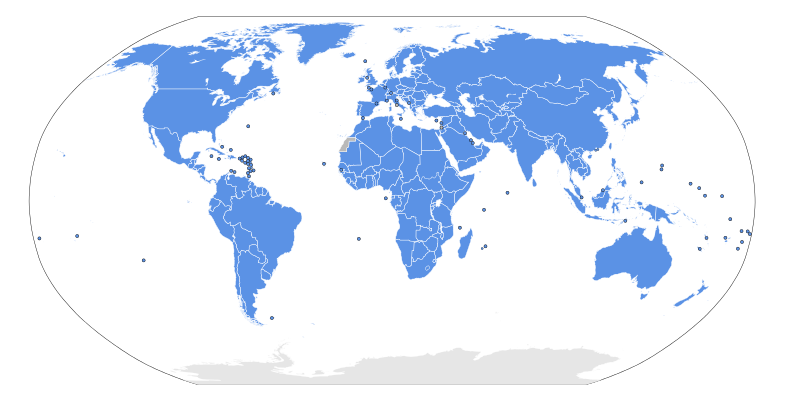 |
Above: Map from 2008 depicting 193 United Nations member states (including dependent territories).
 |
 |
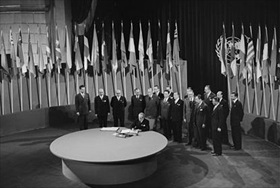
Left: Joaquin Fernandez Y Fernandez, Minister for Foreign Affairs and Chairman of the delegation from Chile, signs the U.N. Charter at a ceremony held at the Veterans’ War Memorial Building in San Francisco on June 26, 1945. Only those states that, by March 1945, had declared war on Germany and Japan and subscribed to the United Nations Declaration were invited to take part in the San Francisco ceremonies.
Right: The first meetings of the United Nations General Assembly (51 nations represented) and the U.N. Security Council took place in London beginning January 6, 1946. The General Assembly selected New York City as the site for its headquarters, and the new facility was completed in 1952. The New York site—like U.N. headquarters buildings in Geneva, Vienna, and Nairobi—is designated as international territory.
Contemporary Newsreel of the San Francisco Conference, June 1945

World War II was the single most devastating and horrific event in the history of the world, causing the death of some 70 million people, reshaping the political map of the twentieth century and ushering in a new era of world history. Every day The Daily Chronicles brings you a new story from the annals of World War II with a vision to preserve the memory of those who suffered in the greatest military conflict the world has ever seen.