

SOVIETS CAPTURE NUCLEAR PHYSICS INSTITUTE
Berlin, Germany · April 25, 1945
In the same month World War II began in Europe, September 1939, the German Army Weapons Agency (Heereswaffenamt, or HWA) placed all programs associated with the nation’s nascent nuclear energy project under its authority. The weapons program eventually expanded into three main efforts: setting up a nuclear reactor, producing uranium and heavy water (deuterium oxide) (the Allies mounted a bombing and sabotage campaign against the Norsk Hydro heavy water plant in German-occupied Norway), and separating uranium isotopes. Likewise, the prestigious and independent Kaiser Wilhelm Institute for Physics (KWIP) in the Berlin suburb of Dahlem was placed under HWA authority. (German-born theoretical physicist Albert Einstein served as its head from 1914 to 1932.) In June 1942 the program, along with its seventy scientists, was handed off to the Reich Ministry for Armament and Ammunition under Albert Speer. Toward the end of the war, the Allied powers competed to obtain surviving components of the Nazis’ nuclear weapons program, just as they famously did with the V‑2 ballistic rocket program. The Soviets used special search teams in conquered territories to identify and “requisition” equipment, materiel, intellectual property, and personnel useful to their atomic research program. On this date in 1945 the Soviets captured Berlin’s Dahlem suburb and with it the Kaiser Wilhelm Institute for Physics. As luck would have it, the Nazis had dispersed much of the institute’s equipment and personnel to the edge of the Black Forest in southwestern Germany, which lay astride the Western Front. This move allowed Allied officers and technical specialists in the secret Operation Alsos, part of the U.S. Manhattan Project, to follow close behind front lines, and occasionally behind enemy lines, and to take into custody most of Germany’s senior nuclear research personnel and technicians, send dismantled equipment and reams of documents back to the U.S. for evaluation, and prevent scientific assets from falling into Soviet hands. With a glass half empty, as it were, the Soviets managed to evacuate a large number of KWIP scientists from Berlin, along with 250 kilograms of metallic uranium, three tons of uranium oxide, and 20 liters of heavy water, to the Soviet Union, giving their nuclear program an important boost.
[amazon_carousel widget_type=”ASINList” width=”600″ height=”200″ title=”Recommended Reading” market_place=”US” shuffle_products=”False” show_border=”False” asin=”0306801892,1563964155,0387950893,1586420674,0300066643,0316103993,0306810115,1451677618,0850528968,0312055102″ /]
Alsos Mission: U.S. and British Intelligence-Gathering Operation, 1944–1945
 |
 |
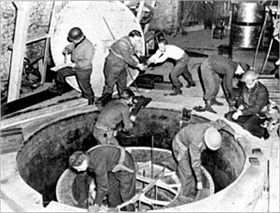
Left: The objective of the Alsos Mission was to secure atomic material and capture the scientists working on the Nazi atomic weapons project. British and American members of the mission are shown dismantling the experimental nuclear reactor that German scientists had built as part of Germany’s nuclear energy project in Haigerloch in the state of Baden-Wuerttemberg. The reactor, shaped like a cylinder and made of graphite blocks, was missing both uranium and heavy water.
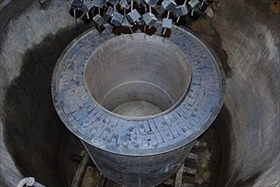
Right: Replica of the German experimental nuclear reactor at Haigerloch Museum. Hanging above the reactor are strings of uranium cubes.
 |
 |
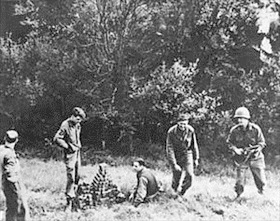
Left: Members of the Alsos Mission uncover uranium cubes hidden in a field in Haigerloch, which is 35 miles southwest of Stuttgart.
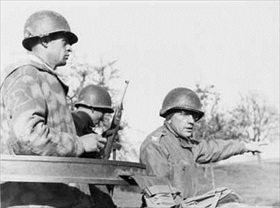
Right: The American sweep of southwestern Germany—an area that was scheduled to be occupied by the French—was led by Col. Borish Pash (right in photo). The sweep denied the French the immediate postwar advantage that accrued to the U.S and British nuclear weapons programs.
National Geographic’s Presentation: The Hunt for Hitler’s Scientists

World War II was the single most devastating and horrific event in the history of the world, causing the death of some 70 million people, reshaping the political map of the twentieth century and ushering in a new era of world history. Every day The Daily Chronicles brings you a new story from the annals of World War II with a vision to preserve the memory of those who suffered in the greatest military conflict the world has ever seen.